Can AI reliably predict facial growth?
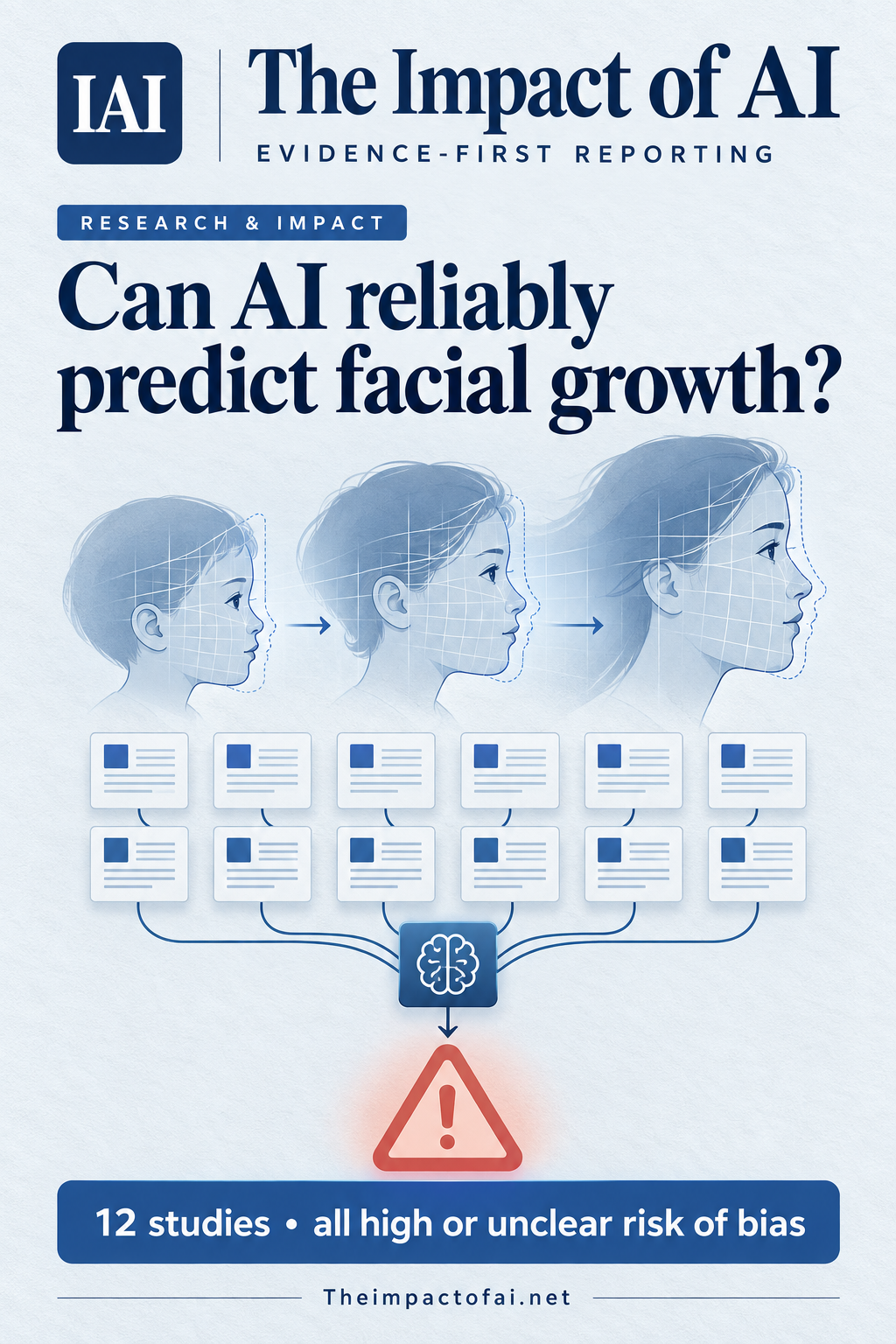
A registered systematic review found 12 studies of AI-based craniofacial or mandibular growth prediction, with samples from 33 to 639 people. Seven studies were at high risk of bias and five at unclear risk; none had independent external validation.
Editorial responsibility: The Impact of AI Editorial Desk · Report a factual concern
At a glance
- 1The reviewers screened 953 unique electronic records and included 12 longitudinal human studies: six on overall craniofacial growth and six on mandibular development.
- 2Samples ranged from 33 to 639 people and prediction horizons from about two to ten years. Outcomes and metrics were too heterogeneous for a meaningful meta-analysis.
- 3Seven studies were judged at high overall risk of bias and five at unclear risk. No included model had independent external validation across a different population or clinical setting.
Research topic
Whether published AI models can predict untreated craniofacial or mandibular growth accurately and robustly enough to support clinical orthodontic decisions
The review asked a clinical question, not a leaderboard question
Orthodontic decisions can depend on how a child's jaw and wider facial structure are expected to grow. Treatment timing, the choice between observation and intervention, and the interpretation of a changing bite can all be influenced by that forecast. AI models promise to learn individual patterns from longitudinal images and measurements instead of relying mainly on population averages or fixed growth templates. The new review asks whether the evidence actually supports that promise in untreated human growth.
The authors searched nine sources through 12 August 2026: MEDLINE/PubMed, Cochrane CENTRAL, Web of Science, Scopus, Virtual Health Library, LIVIVO, IEEE Xplore, ProQuest Dissertations and Theses Global, and Cambridge Core. They also searched manually. Eligible studies had to follow human participants over time, use a machine-learning or deep-learning component to predict later craniofacial or mandibular growth, and report a quantitative performance measure. Diagnostic classifiers and models predicting treatment response rather than natural growth were excluded.[1]
The Impact Brief · Free
Follow the evidence in health & life sciences.
Get a five-minute weekday briefing on what changed, why it matters and where the evidence comes from. Choose the topics you care about.
Only 12 studies survived the eligibility process
The electronic search produced 1,151 records. After 198 duplicates were removed, 953 titles and abstracts were screened, 26 reports reached full-text review and ten qualified. Manual searching added two, making 12 studies in the final synthesis. Six attempted to predict overall craniofacial growth and six focused on the mandible. The denominator matters: a rapidly discussed clinical use case rests on a small and methodologically varied research base.
Sample sizes ran from 33 to 639 participants. Approximately half the papers reused longitudinal records from the American Association of Orthodontists Foundation Legacy Collection; others used separately collected cohorts. That archive is valuable because ethical and practical constraints make untreated long-term growth data difficult to obtain. But repeated dependence on the same historical resource also limits independence and population breadth. The review notes that the archive primarily represents people of European ancestry, while several other studies used Asian samples.[1]
Prediction tasks and time horizons were not comparable
Forecast horizons ranged from short-term periods of roughly two years to projections extending about ten years. Some studies predicted continuous cephalometric measurements, some forecast landmark coordinates, and others classified clinically defined growth patterns. Researchers used Lasso and Ridge regression, random forests, XGBoost, support-vector regression and multilayer perceptrons alongside convolutional, graph and TabNet-based neural networks. Reported outcomes included mean absolute error, mean error, root mean square error, Euclidean distance and percentage accuracy.
Those differences prevented the reviewers from pooling results into a single accuracy estimate. A millimetre error on one landmark cannot be compared directly with a classification percentage for another anatomical target. A two-year forecast also asks less of a model than a ten-year forecast. Six papers addressing whole-face growth and six addressing mandibular development are not interchangeable, and a result obtained from a selected skeletal class cannot simply be carried into another. The review therefore used a narrative synthesis rather than manufacturing a meta-analytic average from incompatible endpoints.[1]
Every study had a serious or unresolved risk-of-bias concern
The reviewers used PROBAST, a structured tool for evaluating prediction-model studies. Seven of the 12 papers were judged at high overall risk of bias; the remaining five were unclear. The analysis domain created the largest problems. Some models were complex relative to the number of participants, some had internal validation that was insufficient to control optimism, and at least one used a potentially inappropriate cross-validation strategy. Even a technically impressive error score can be optimistic if model choices are repeatedly tuned against a small, reused dataset.
Predictor assessment was unclear in 11 studies and high risk in one, largely because papers did not report whether baseline predictor measurements were assessed without knowledge of later outcomes. Outcome assessment was unclear in every study for a similar reason. Those judgments do not prove that assessors were biased; they show that reporting did not let reviewers rule bias out. The distinction is important because an 'unclear' rating should not be read as evidence of methodological safety.[1]
No model had independent external validation
Nine studies used a fixed training/test or training/validation/test allocation, while three used cross-validation without a fixed split. Those procedures can estimate internal performance if they are implemented correctly and keep all records from the same participant together. They cannot establish transportability. The review found no independent external validation across a new institution, population or clinical setting. That absence is the central obstacle to using the models for individual care.
Population restrictions deepen the concern. Several studies were limited by sex, ethnicity, skeletal class or membership in a historical archive. Sex and malocclusion type often defined who entered a study but were not consistently included as predictors; ethnicity and skeletal maturation were rarely examined. Craniofacial development reflects genetics, maturation, environment and function. A model can appear accurate within a narrow sample while failing when the distribution of those factors changes.[1]
Promising numbers do not establish superiority over standard methods
Individual papers reported encouraging performance, and a few direct comparisons found machine-learning models outperforming partial least-squares regression. The review nevertheless concludes that the evidence is insufficient to say AI is generally superior to conventional statistical prediction. Only a minority of studies made a direct, clinically meaningful comparison, and differences in populations, targets and metrics block a fair ranking of algorithms.
This is not a conclusion that AI cannot help. It is a conclusion about the present evidence boundary. A model may be useful for research, visualization or generating a second opinion without being ready to determine treatment timing. In paediatric care, errors can matter over years: overconfidence could encourage unnecessary intervention, while a missed growth pattern could delay an option. The safe interpretation is that current systems remain candidate decision-support tools requiring specialist judgment and local validation.[1]
Funding and protocol changes were disclosed
The review was registered in PROSPERO as CRD420251172592 and followed PRISMA 2020. The paper explains two changes from the registered plan: the authors expanded the information sources and used PROBAST rather than the Newcastle-Ottawa Scale because PROBAST is designed for prediction-model studies. Transparent amendments are preferable to silent changes and give readers a basis for judging whether the final method still answers the original question.
Open-access funding came from the University of Catania under an institutional agreement. The authors declared no competing interests. Funding and disclosures do not determine whether a review is correct, but they belong with the evidence—especially where a positive conclusion could influence a growing commercial market. The review's cautious conclusion is consistent with its risk-of-bias findings and does not promote a specific product.[1]
What would change the assessment
The strongest next study would lock a model and evaluate it prospectively across multiple clinics with different scanners, populations and orthodontic practices. Participants should be separated at every stage of development and testing, with no image or timepoint leakage. Investigators should prespecify a clinically interpretable outcome, compare the system with accepted statistical methods and specialist forecasts, report calibration and uncertainty as well as average error, and stratify results by age, sex, ancestry, skeletal pattern and maturation stage.
Clinical utility also requires more than geometric accuracy. A trial should ask whether the forecast changes a treatment decision appropriately, whether clinicians understand when the model is uncertain, and whether follow-up confirms benefit without avoidable intervention. Independent replication on genuinely external data would materially strengthen the assessment. Until then, the 12-study review supports continued research and careful assisted use—not routine reliance on AI as a reliable predictor of an individual child's facial growth.[1]
What this means for people
- Families may encounter impressive accuracy claims even though current studies do not show dependable performance across populations or clinics.
- Orthodontists can use experimental predictions as one input, but should retain responsibility for interpretation, uncertainty and follow-up.
- Children should not receive irreversible or time-sensitive treatment solely because a model extrapolated from a small or historically narrow dataset.
Global context
The evidence combines North American historical archives and separate Asian and other cohorts, while the review team is based in Italy. That breadth does not equal global validation: models were usually developed and tested inside one dataset, with restricted demographic and clinical information. International use would require local validation and transparent reporting of who was represented, how growth was measured and whether the same prediction remains reliable in another health system.
What the evidence does not yet show
- The review included only English-language reports and may have missed eligible work in other languages or difficult-to-index sources.
- Only 12 studies qualified, with sample sizes from 33 to 639 and widely different targets, metrics and prediction horizons.
- About half of the evidence reused one historical orthodontic archive, limiting independence and population breadth.
- No meta-analysis was possible because outcomes and methods were too heterogeneous for a meaningful pooled estimate.
- Every study was at high or unclear overall risk of bias, and none supplied independent external validation.
What to watch next
- Prospective multicentre evaluation of locked models on patients from institutions not involved in development.
- Head-to-head comparisons with conventional growth forecasts and experienced orthodontists using the same outcome and horizon.
- Calibration, uncertainty and subgroup performance across age, sex, ancestry, skeletal pattern and maturation stage.
- Evidence that predictions improve treatment timing or patient outcomes rather than only reducing geometric error.
Living evidence record
Impact record IAI-0297M1R
Evidence stage
Studied
Confidence
Supported
Reporting basis
Source analysis
Independent or research support
Present
Record status
Monitoring
Last checked
5 October 2026
Source trail
1 direct source across 1 source type.
People impact
Documented in this record.
Uncertainty
Limits and next checks are explicit.
Stages describe the evidence available—not whether a technology is good or bad. See the public method.
Single-source reporting disclosure
This record analyses one direct source. It can establish what Clinical Oral Investigations published or reported, but it is not independent corroboration of every performance claim or predicted outcome. The confidence label will change only when broader evidence is added.
Evidence trail
Sources used for this report
Links checked 5 October 2026
This report is labelled source analysis. We summarise and analyse source material in our own words; company statements remain attributed claims until independently supported. Translated summaries preserve the meaning of the original source and link back to it. Read our editorial standards.
Continue the story
Related reporting
Health & Life Sciences
Can brain MRI reveal more than BMI?
A peer-reviewed study trained a deep-learning model on 45,702 MRI scans from six cohorts. Brain-derived features tracked BMI and separated several disease groups better than BMI alone—but the disease analysis stayed inside UK Biobank and cannot establish cause, diagnosis or clinical benefit.
9 min · 2 sources
Health & Life Sciences
Can a chest X-ray flag osteoporosis?
A peer-reviewed Korean study externally validated an AI prescreener in three cohorts totalling 153,058 people. Its simulated workflow preserved most osteoporosis detections while halving DXA use, but it has not yet proved benefit in prospective care.
7 min · 2 sources
Health & Life Sciences
Can AI estimate survival after a Parkinson’s diagnosis?
A peer-reviewed Chinese registry study compared four survival models in 3,148 people with Parkinson’s disease. A transparent Cox model matched the machine-learning alternatives, but validation stayed within the same registry and no clinical-impact study was performed.
9 min · 2 sources
Reader commentary
Add evidence, experience or a question
No account is required. Reader notes are published after a brief civility, relevance and safety check; disagreement is welcome.
Explore commentary across the portal →Published reader notes
0No published reader notes yet. You can start the evidence-led discussion above.
Prefer a private correction or response? Contact the newsroom.