Who is gaining from AI at work?
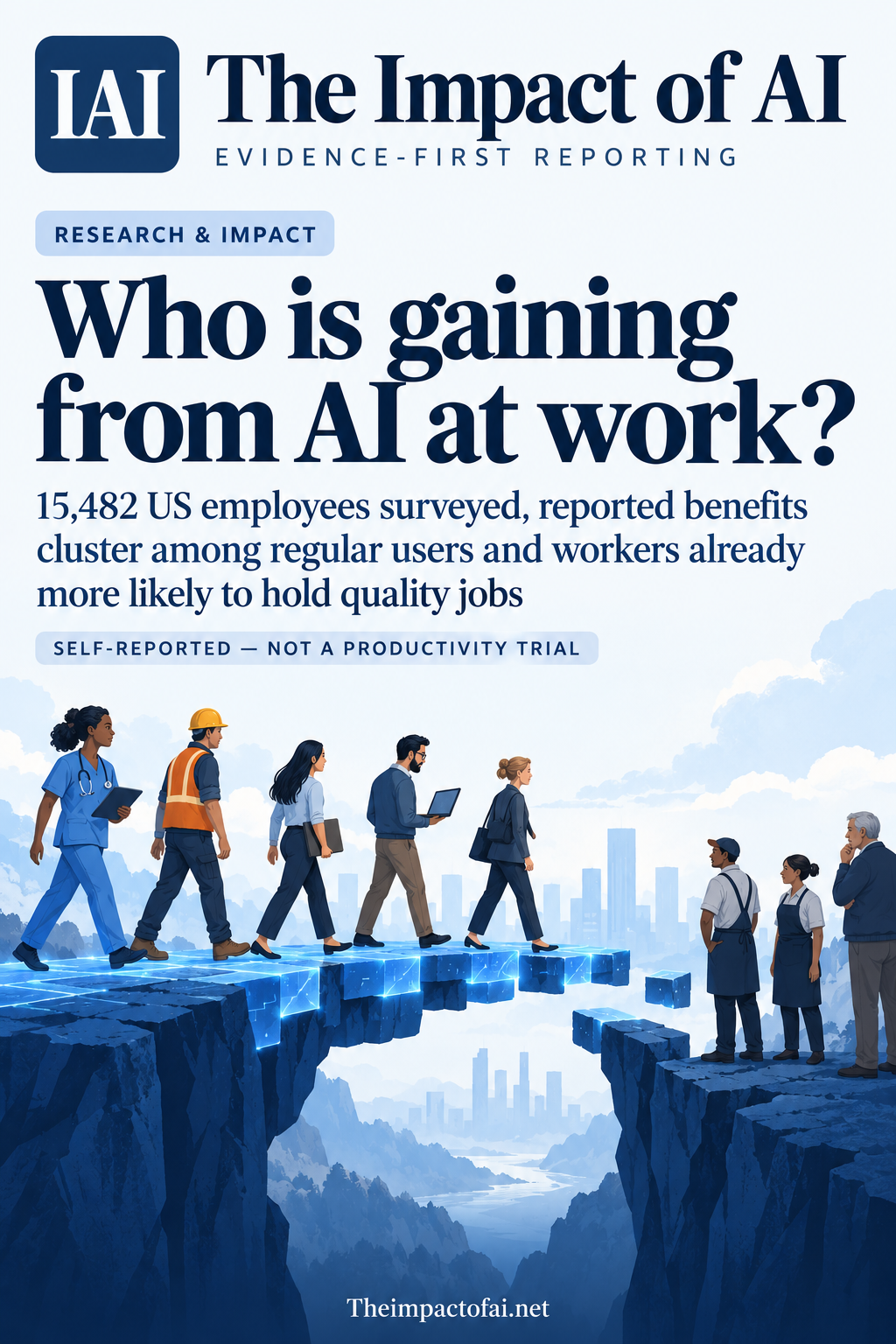
A Gallup survey of 15,482 US employees finds that regular AI users report more speed, creativity and work quality, but frequent use is concentrated among graduates, managers and workers who already have better jobs. The results are self-reported associations, not a productivity trial.
Editorial responsibility: The Impact of AI Editorial Desk · Report a factual concern
At a glance
- 1Gallup surveyed 15,482 US employees from 26 January to 24 March 2026; reported effects were analysed among 7,845 people who had used AI at work at least a few times in the previous year.
- 2Among AI users, 63% said it helped them work faster and 56% reported more creative solutions, but these are self-assessments rather than employer ratings or measured output.
- 3Frequent use was reported by 40% of graduates versus 17% of non-graduates, while 52% of all employees said they had less influence over workplace technology adoption than they wanted.
Research topic
Who reports benefits from workplace AI, how access differs across the US workforce and why the survey cannot establish productivity gains
The answer: reported gains are concentrated, not universal
US employees who already use artificial intelligence regularly are the group most likely to report that it helps them work faster, think more creatively, improve quality and spend time on more interesting tasks. But access to that experience is uneven. Gallup's first 2026 findings from the American Job Quality Study show frequent use is much more common among college graduates and managers than among people without degrees or individual contributors. The people most exposed to the apparent upside are also more likely to hold jobs that already score well on Gallup's broader quality criteria.
That makes the headline neither a verdict that AI raises productivity nor proof that it worsens inequality. It is a large, nationally focused survey describing who says they use AI and what those users believe changed. The strongest practical finding is distributional: any employer or policymaker promising shared gains needs to explain how workers in retail, manufacturing production, healthcare support and other lower-use roles will obtain useful tools, training and influence without simply inheriting extra targets or monitoring.[1][2]
The Impact Brief · Free
Follow the evidence in work & skills.
Get a five-minute weekday briefing on what changed, why it matters and where the evidence comes from. Choose the topics you care about.
What was measured and who was included
The 2026 survey ran from 26 January to 24 March. Comparisons of AI use and job quality draw on 15,482 US employees. Questions about the effects of AI were asked of 7,845 employees who said they had used AI in their job at least a few times during the previous year. Gallup defines frequent use as daily or weekly use. Twenty-eight per cent of employees fell into that category, while 54% said they had not used AI in their role.
The study's job-quality framework covers financial wellbeing, workplace culture and safety, growth and development, agency and voice, and work structure and autonomy. That is broader than pay or job satisfaction alone. However, the published AI results are observational and cross-sectional: workers were not randomly assigned a tool, employers did not supply a common output measure, and the analysis does not compare otherwise identical jobs before and after adoption. The full second-year report is due later in October, so weighting, item wording and further methodological detail may add context.[1][2]
The reported benefits—and the added workload signal
Among employees who had used AI at work, 63% said it helped them do their job faster and 56% said it helped them find more creative solutions. Forty-seven per cent reported more time for the most interesting parts of their job, and 46% reported higher-quality work. Regular users were substantially more positive than irregular users: 79% versus 38% for speed, 67% versus 39% for creativity, 59% versus 26% for quality, and 61% versus 27% for time on interesting work.
Speed did not automatically translate into relief. Thirty-one per cent of AI users said their employer had asked them to take on more responsibilities because of their AI use; the proportion was 37% among those who said AI made them faster. That does not show exploitation, because the survey does not establish whether responsibilities came with higher pay, greater autonomy or promotion. It does show why a productivity discussion that ignores workload, reward and worker voice is incomplete. A saved hour can become recovery time, better service, learning—or simply another hour of expected output.[1]
Why access and job quality are tangled together
Forty per cent of college graduates said they used AI daily or weekly, compared with 17% of employees without a degree. Thirty-seven per cent of managers were frequent users, against 25% of individual contributors. Roughly half of employees in professional and business services, finance, and information or media used AI regularly, while 70% to more than 80% of employees in healthcare support, manufacturing production and retail sales said they never used it in their role.
Regular users were also more likely to have a quality job: 52%, compared with 46% of infrequent users and 32% of non-users. Gallup explicitly warns that the same characteristics associated with quality jobs—education, management status and industry—are also associated with AI use. It would therefore be wrong to infer that AI caused the job-quality difference. Better jobs may offer more digital access, discretion and training; workers with more resources may be able to experiment; and roles that are easier to digitise may attract both higher pay and more AI exposure.[1]
What changes for workers and employers
For workers, the useful question is not whether an employer has bought an AI licence but whether the tool helps with a defined task, whether its output can be checked, and who receives the value of saved time. Training should include error detection and data handling, not just prompt techniques. Employers should track workload, pay, autonomy, quality, rework and stress alongside speed. Where a system reallocates responsibilities or changes performance expectations, workers need a real channel to challenge the design and report harms.
Gallup reports that 52% of all employees had less influence over adoption of new technology than they wanted. That is a direct implementation warning. AI introduced without worker input can miss how work is actually done, shift invisible checking labour to frontline staff or encode management assumptions into workflows. Conversely, participation can reveal tasks that are genuinely repetitive, identify groups excluded from training and establish when automation should assist rather than decide. Worker voice is therefore part of the evidence, not merely a communications exercise after deployment.[1][2]
What would change the assessment
Confidence would increase with the full 2026 methodology, transparent weighting and question wording, repeated measurements of the same workers, and links between reported benefits and objective task outcomes such as error rates, throughput, service quality, pay, hours and promotion. Randomised or carefully matched workplace studies could separate tool effects from differences in occupation, education, management status and employer quality. International replication would show whether the US pattern survives different labour markets and technology policies.
The assessment would weaken if reported gains disappear in longitudinal data, if faster work produces more unpaid responsibilities or if low-access groups remain excluded from tools and training. It would strengthen if employers can show gains shared through better pay, safer workloads, progression and meaningful worker control. For now, the defensible conclusion is specific: many US users perceive benefits, but the survey does not prove productivity and the people most likely to use AI frequently are already advantaged in the labour market.[1][2]
What this means for people
- Regular users often perceive faster and more creative work, but many workers have little or no direct access to AI in their role.
- Nearly one-third of users reported added responsibilities, making pay, workload and autonomy essential parts of any productivity claim.
- Workers without degrees and those outside management use AI less often, raising the risk that existing labour-market advantages compound.
Global context
The survey covers US employees and should not be treated as a global workforce estimate. Job design, digital access, labour protections, bargaining power and education systems differ across countries. The distributional question is international, but the exact use rates and job-quality relationship require local measurement.
What the evidence does not yet show
- The reported effects are employees' assessments; the study did not directly measure output, quality, errors, wages or employer-rated performance.
- The published comparisons are observational and cannot establish whether AI use caused better job quality or reported benefits.
- Role, industry, education, pay and management status differ between frequent users, infrequent users and non-users.
- The AI-effect questions use 7,845 prior users; broader use and job-quality comparisons use 15,482 employees.
- The full second-year report and additional methodological detail are scheduled for later in October 2026.
What to watch next
- Gallup's full second-year American Job Quality Study report and technical documentation.
- Longitudinal evidence linking AI adoption to wages, workload, errors, output and progression.
- Whether employers give frontline workers more influence over technology implementation.
- Training and access for lower-use sectors, non-graduates and individual contributors.
- Evidence that time savings are shared rather than converted only into added responsibilities.
Living evidence record
Impact record IAI-076W4WN
Evidence stage
Observed
Confidence
Supported
Reporting basis
Multi-source analysis
Independent or research support
Not yet
Record status
Monitoring
Last checked
6 October 2026
Source trail
2 direct sources across 1 source type.
People impact
Documented in this record.
Uncertainty
Limits and next checks are explicit.
Stages describe the evidence available—not whether a technology is good or bad. See the public method.
Evidence trail
Sources used for this report
Links checked 6 October 2026
This report is labelled multi-source analysis. We summarise and analyse source material in our own words; company statements remain attributed claims until independently supported. Translated summaries preserve the meaning of the original source and link back to it. Read our editorial standards.
Continue the story
Related reporting
Work & Skills
IDB projects an AI growth dividend for Latin America, with wages dependent on mobility
Preliminary scenarios put regional output between 0.3% and 5.1% higher after a decade. Workers' ability to move into expanding roles determines whether wages rise or fall in the model.
3 min · 2 sources
Work & Skills
ILO evidence review finds productivity gains alongside risks to autonomy and junior work
An ILO review of empirical studies says generative AI can improve performance on some tasks while raising concerns about inequality, early-career opportunities, worker autonomy and how jobs are organised.
2 min · 1 source
Work & Skills
Does an AI label bias code review—or does job rank matter more?
In a randomized vignette experiment, 447 Microsoft engineers did not penalize an AI-use disclosure on identical code, but rated the same code and author more favourably when the fictional author was labelled Principal rather than Level 1. One AI-normalized US workplace cannot settle how other teams respond.
9 min · 2 sources
Reader commentary
Add evidence, experience or a question
No account is required. Reader notes are published after a brief civility, relevance and safety check; disagreement is welcome.
Explore commentary across the portal →Published reader notes
0No published reader notes yet. You can start the evidence-led discussion above.
Prefer a private correction or response? Contact the newsroom.