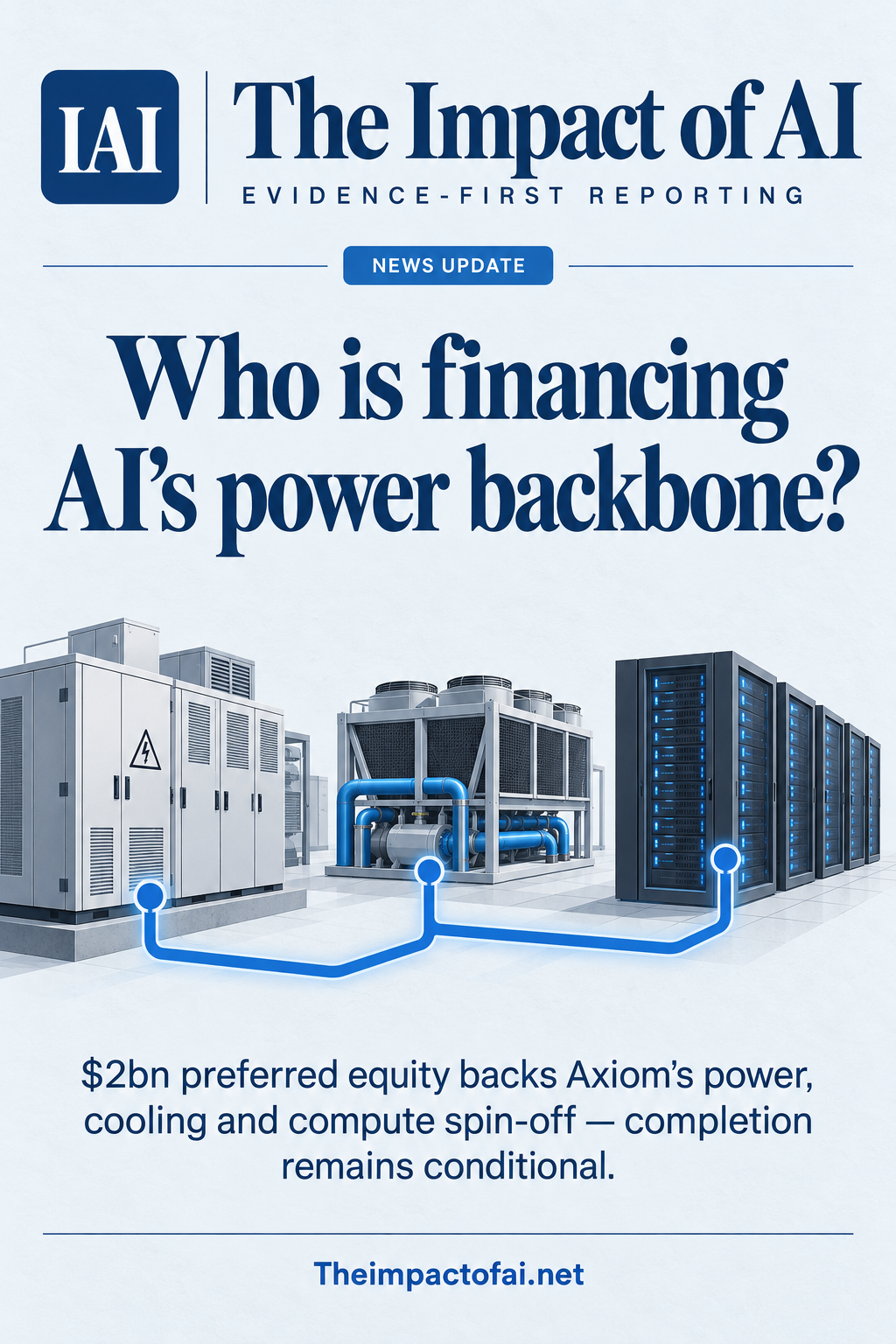
Who is financing AI's power backbone?
General Catalyst, Koch Equity Development and co-investors have agreed to put $2 billion of preferred equity into Axiom at a $37.5 billion enterprise value. The capital is expensive, the separation is unfinished and the disclosed terms do not prove AI demand will deliver the promised returns.
Editorial responsibility: The Impact of AI Editorial Desk · Report a factual concern
At a glance
- 1Flex says General Catalyst, Koch Equity Development and co-investors have agreed to buy $2 billion of Axiom preferred shares at an initial enterprise value of $37.5 billion.
- 2The security pays a 10% annual cash dividend before separation, then 6% in cash or 7% if paid in kind; General Catalyst would gain the right to nominate one Axiom director after separation.
- 3The investment, EPC Power acquisition and planned first-quarter 2027 separation remain conditional, and the filing does not provide independent proof that AI-infrastructure demand will justify the valuation.
Research topic
What the disclosed preferred-equity terms reveal about how investors are financing power, cooling and compute infrastructure for AI data centres
The answer: private capital is backing the physical bottlenecks
General Catalyst, Koch Equity Development and unnamed co-investors have agreed to provide $2 billion of convertible preferred equity to Axiom Solutions International, the cloud-and-power infrastructure business that Flex plans to separate. Flex gives Axiom an initial enterprise value of $37.5 billion and says the separation is expected in the first quarter of 2027. This is financing for the equipment around AI computing—power conversion, thermal management and scalable infrastructure—not an investment in a new foundation model.
That distinction matters. Model developers attract most public attention, but new data centres also need grid connections, transformers, power electronics, backup systems, cooling and manufacturing capacity. A large preferred-equity commitment signals that investors expect these constraints to remain commercially valuable. It does not show how much of Axiom's future revenue will come from AI workloads, how quickly customers will build capacity or whether projected margins will survive competition and construction delays.[1][2]
The Impact Brief · Free
Follow the evidence in finance & business.
Get a five-minute weekday briefing on what changed, why it matters and where the evidence comes from. Choose the topics you care about.
The terms show capital is available, but not cheaply
Before the planned separation, the preferred stock carries a 10% annual cash dividend. After separation, the rate steps down to 6% if paid in cash or 7% if Axiom pays in kind by adding the dividend to the security rather than distributing cash immediately. The terms are subject to increases after the fifth anniversary and other adjustments. On a $2 billion principal amount, a 10% rate implies $200 million a year before considering timing, adjustments or any conversion mechanics not detailed in the announcement.
Preferred equity sits ahead of ordinary shareholders for its contractual economics and can reduce near-term dilution compared with issuing common shares, but its dividend burden is real. Paying in kind can conserve cash after separation while increasing the amount owed. The announced enterprise value should not be mistaken for a public-market price discovered through trading. It is the transaction's stated starting valuation and remains dependent on the financing and separation completing on the disclosed terms.
General Catalyst would also receive the right to nominate one director to Axiom's board after the separation. That governance right gives the lead investor influence alongside the economic protections. Flex did not disclose the complete investor allocation, conversion price, liquidation preference or all adjustment provisions in the press release and exhibit, so readers cannot reconstruct the full return profile from these documents alone.[1][2]
Where the money is intended to go
Flex says net proceeds may fund part of Axiom's pending acquisition of EPC Power, repay bridge or intermediate financing used for that purchase, pay dividends on the preferred stock or support general corporate purposes. Flex says it has separately arranged committed term-loan financing for the remaining acquisition cost. In other words, the capital is partly acquisition finance and balance-sheet preparation for the spin-off, not a ring-fenced promise to build a specified number of data-centre sites or add a disclosed quantity of power capacity.
That is why the announcement should not be translated into a claim that $2 billion will become $2 billion of new AI infrastructure. Money can refinance an earlier obligation, pay transaction costs or support working capital. The documents provide no denominator for additional megawatts, cooling units, factory capacity, customers or deployment dates attributable to this investment. Those operating measures will matter more to communities, grid planners and customers than the headline valuation alone.[1][2]
What changes for workers, customers and communities
If Axiom expands, manufacturers and suppliers may see demand for electrical equipment, cooling systems, assembly and field services. Data-centre customers could gain another scaled supplier able to combine power, thermal and compute infrastructure. Yet a corporate separation can also create uncertainty over reporting lines, benefits, systems and capital allocation. Flex itself lists employee departures, management distraction, integration problems and disruption to customer and supplier relationships among the risks.
For communities, the financing is several steps removed from a local project. A better-capitalised supplier may enable faster construction, but each facility still needs land, grid capacity, water or alternative cooling, permits and a credible plan for who pays for network upgrades. No community should treat a financing announcement as evidence that a specific project is approved, low-carbon or beneficial. Those conclusions require site-level capacity, energy, water, jobs and cost-allocation evidence.[1]
What the filing proves—and what it leaves open
The issuer announcement and SEC exhibit establish that an agreement was announced on 5 October, identify the investors named by Flex, state the principal amount and initial enterprise value, and disclose headline dividend and governance terms. They also state that closing requires regulatory approvals and customary conditions. They do not prove that the investment has closed, that the EPC Power acquisition will complete, that the separation will occur on schedule or that either company will achieve the expected strategic and financial benefits.
Both documents are company-originated. Filing an announcement with the SEC makes it an official public record, but it does not turn management's projections into independently verified outcomes. The risk section explicitly warns that timing, approvals, integration, ratings, tax treatment, capital structure, employee retention and market conditions could change the result. It also directs investors to the Form 10 and future proxy materials for fuller information.[1][2]
What would change the assessment
The assessment would strengthen when the investment and EPC Power acquisition close, final terms are filed and Axiom publishes audited financial statements that separate AI-related infrastructure demand from the rest of its business. Useful operating evidence would include customer concentration, backlog quality, capacity delivered on time, power and cooling efficiency, warranty performance, capital expenditure, cash generation and the share of revenue tied to completed rather than proposed data-centre projects.
It would weaken if approvals are delayed, the separation slips, preferred dividends consume more cash than expected, bridge financing grows, major customers defer construction or integration costs erode the anticipated benefits. Until closing and audited performance data arrive, the defensible conclusion is narrow: sophisticated investors have committed substantial capital on protected terms to a company positioned around AI's physical infrastructure bottlenecks. The return and public benefit remain unproven.[1][2]
What this means for people
- Workers and suppliers may benefit if investment expands manufacturing and installation, but the separation and acquisition also create integration and employment uncertainty.
- Data-centre customers may gain capacity and an integrated supplier, while bearing prices shaped by financing costs and equipment constraints.
- Communities still need project-specific evidence on grid upgrades, water, land, jobs and cost allocation; a corporate financing does not answer those questions.
Global context
Flex operates across 30 countries and AI-infrastructure supply chains are global, but the disclosed financing and planned separation are US corporate transactions. Power availability, equipment lead times, permitting, water stress and community consent vary sharply by region. The deal therefore signals international investor demand for infrastructure suppliers without establishing that any particular country or project will receive new capacity.
What the evidence does not yet show
- The investment, EPC Power acquisition and planned Axiom separation have been announced but have not been reported as completed.
- The $37.5 billion figure is the transaction's stated initial enterprise value, not an independently tested public-market valuation.
- The company materials do not quantify how much of Axiom's revenue, backlog or future capacity is attributable specifically to AI workloads.
- The announcement does not provide enough detail to reconstruct all conversion, liquidation and adjustment terms of the preferred security.
- No site-level evidence is supplied for additional capacity, energy use, water demand, emissions, employment or community costs enabled by the investment.
What to watch next
- Regulatory approval and closing of the preferred-equity investment and EPC Power acquisition.
- Axiom's final separation documents, capital structure and full preferred-security terms.
- Audited revenue, margin, cash-flow, backlog and customer-concentration data after separation.
- Operating evidence linking investment to delivered power, cooling and compute capacity rather than announced projects.
- Project-level disclosure of grid, water, emissions, workforce and community effects.
Living evidence record
Impact record IAI-09R6R1Y
Evidence stage
Announced
Confidence
Supported
Reporting basis
Multi-source analysis
Independent or research support
Not yet
Record status
Monitoring
Last checked
6 October 2026
Source trail
2 direct sources across 2 source types.
People impact
Documented in this record.
Uncertainty
Limits and next checks are explicit.
Stages describe the evidence available—not whether a technology is good or bad. See the public method.
Evidence trail
Sources used for this report
Links checked 6 October 2026
This report is labelled multi-source analysis. We summarise and analyse source material in our own words; company statements remain attributed claims until independently supported. Translated summaries preserve the meaning of the original source and link back to it. Read our editorial standards.
Continue the story
Related reporting
Finance & Business
Does Micron's record quarter prove the AI infrastructure boom will last?
Micron reported $54.23 billion in quarterly revenue and $32 billion of customer commitments under long-term supply agreements. The figures show extraordinary demand for memory and storage, but the company's outlook is not proof that every AI investment will earn a return.
6 min · 3 sources
Finance & Business
Samsung affiliates commit US$1 billion to Helix AI infrastructure
Samsung Electronics will invest US$500 million and five affiliates the remainder, the company says. The 29 September commitment spans data centres, power and connectivity, but no completed capacity is demonstrated by the announcement.
4 min · 2 sources
Finance & Business
AI infrastructure borrowing forecast at $420bn in 2027 as bond buyers demand more
Goldman Sachs data cited by Reuters projects record gross hyperscaler issuance next year. Investors are asking whether data-centre returns justify the scale and concentration of borrowing.
3 min · 1 source
Reader commentary
Add evidence, experience or a question
No account is required. Reader notes are published after a brief civility, relevance and safety check; disagreement is welcome.
Explore commentary across the portal →Published reader notes
0No published reader notes yet. You can start the evidence-led discussion above.
Prefer a private correction or response? Contact the newsroom.