What would SAP gain from TechWolf?
SAP has signed an agreement to acquire TechWolf, whose software maps tasks, skills and labour-market signals for workforce planning. The price is undisclosed, closing remains conditional and no public evidence yet shows that deeper integration will improve hiring, reskilling or job design.
Editorial responsibility: The Impact of AI Editorial Desk · Report a factual concern
At a glance
- 1SAP and TechWolf say they have signed an acquisition agreement, with closing expected in Q4 2026 subject to regulatory approval and customary conditions.
- 2TechWolf's model links tasks, workforce skills and external labour-market information; SAP plans to use it in SuccessFactors and to ground workforce-related agent queries.
- 3The price, full contractual terms, retention commitments and independently verified customer outcomes are not disclosed, so the strategic promise cannot yet be translated into realised value.
Research topic
What SAP's proposed TechWolf acquisition would add to enterprise workforce systems and what remains unproven before closing and integration
The answer: a workforce context layer for enterprise AI
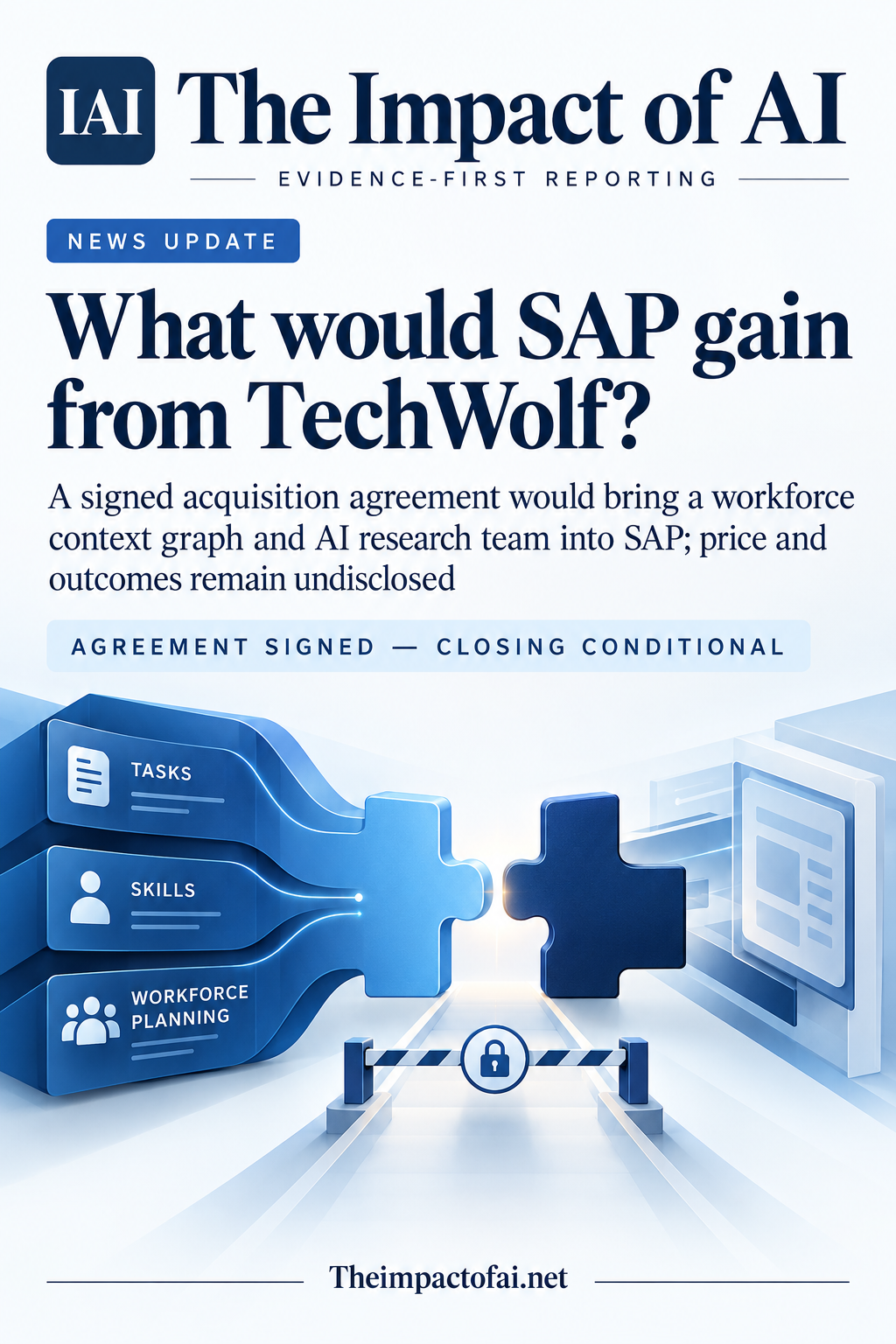
SAP would gain a structured way to connect the work people perform, the skills they use and signals from the external labour market. TechWolf calls this a context graph for work. SAP says the acquisition would bring that model, associated AI systems and an applied research team into the company, with deeper use across SuccessFactors for workforce planning, skills-based hiring, internal mobility, reskilling and role redesign.
The strategic logic is that an AI assistant cannot answer a workforce question well if it only knows job titles and static competency lists. It needs current evidence about tasks, capabilities, organisational priorities and market demand. A context layer could help an agent retrieve a smaller, more relevant set of data before generating a recommendation. That may reduce irrelevant output and computational cost. It does not guarantee that the underlying skills inference is accurate, fair or appropriate for a consequential employment decision.[1][2]
The Impact Brief · Free
Follow the evidence in finance & business.
Get a five-minute weekday briefing on what changed, why it matters and where the evidence comes from. Choose the topics you care about.
What has happened—and what has not
The companies announced an agreement on 6 October and expect the transaction to close in the fourth quarter of 2026. Closing is subject to regulatory approval and the usual conditions. The announcement does not say that ownership has transferred. It also does not disclose the purchase price, payment structure, earn-outs, employee-retention arrangements, intellectual-property allocation or any material termination provisions.
SAP says it plans to keep TechWolf independent under chief executive Andreas De Neve, with its Ghent headquarters and offices in London, New York and San Francisco, and to keep the platform available to SAP and non-SAP customers. Each point is described as a plan, subject to closing and required consultation. Customers should therefore distinguish continuity intentions from binding service commitments and wait for product, contract, data-hosting and support details.[1]
How the claimed product fits together
TechWolf says its platform combines three views: skills already present or needed inside an organisation, how tasks and roles are changing, and what is happening in the wider labour market. The acquisition announcement says the system connects to existing HR and business tools and represents work down to tasks inside a job. SAP wants that structure to inform SuccessFactors and its Joule assistant when leaders ask about hiring, deployment, development and organisational redesign.
This is potentially more useful than asking a general-purpose model to infer a workforce plan from unstructured documents. Yet each layer can be wrong. Job descriptions may be stale; activity data may omit informal work; market postings can reproduce fashionable but unnecessary requirements; and a model can infer a skill from a task without knowing proficiency. If these uncertainties are hidden behind a confident interface, a better-organised dataset can still produce a poor decision faster.[1][2]
What changes for workers and HR teams
For HR teams, a common skills and task model could reduce manual taxonomy work and make it easier to compare current capabilities with future roles. Employees might receive more relevant learning or internal-mobility suggestions. Managers could identify work suited to augmentation rather than treating an entire occupation as automatable. Those benefits depend on the data being current and on workers having a way to correct what the system says about them.
The same system could also increase surveillance or turn uncertain inferences into hiring, promotion or redundancy filters. A skill inferred from software activity is not the same as competence assessed in context. A task classified as automatable is not evidence that removing a person will preserve safety, service or tacit knowledge. Employers deploying these tools should disclose data sources, allow corrections, test for disparate effects and retain accountable human review for consequential decisions.[1][2]
The evidence gap behind the deal
SAP says joint customers have seen measurable results, and TechWolf's site presents product claims and selected customer examples. The acquisition announcement does not provide a study design, customer denominator, baseline, comparator, confidence interval or audited result that would let readers judge those claims. It also does not show how often inferred skills are correct across languages, industries and job levels, or how recommendations affect hiring quality, retention, pay and access to opportunity.
That evidence gap is normal in an acquisition announcement but important because the product sits near decisions that shape careers. Strategic fit, commercial value and social value are different questions. SAP may gain a differentiated data asset even if some use cases remain unvalidated. Customers may gain faster planning while workers experience new errors or less control. Responsible assessment needs outcome measures for each deployment rather than relying on the existence of a graph, model or research team.[1][2]
What would change the assessment
The assessment would strengthen after the transaction closes and SAP discloses integration milestones, data-governance rules, model evaluations and independently checkable customer outcomes. Useful measures would include skill-extraction accuracy, error rates across demographic and language groups, successful internal moves, training completion, hiring quality, employee corrections, appeals and whether recommendations improve pay or progression without increasing adverse impact.
It would weaken if closing slips, TechWolf loses key researchers, non-SAP access narrows, customer data becomes harder to separate or workforce agents act on opaque inferences without meaningful review. Until then, the conclusion is limited: SAP has signed for a workforce-intelligence capability that could make enterprise AI more context-aware. The price, completed ownership, product integration and benefits to employers or workers remain unproven.[1][2]
What this means for people
- Employees could receive better-targeted learning and internal-opportunity recommendations, but inaccurate inferences could also affect careers.
- HR teams may spend less time maintaining taxonomies while taking on new duties to audit data quality, fairness and appeals.
- Customers need continuity and governance details before treating the acquisition as evidence of improved workforce decisions.
Global context
SAP serves multinational employers, while TechWolf is headquartered in Belgium and operates across Europe and the United States. Workforce data, employment law, consultation rights and acceptable automated decision-making vary by jurisdiction. A shared technical layer will therefore need local governance rather than one universal deployment rule.
What the evidence does not yet show
- The transaction is signed but not reported as closed; regulatory approval and customary conditions remain outstanding.
- Financial terms and full contractual provisions are undisclosed.
- Claims about measurable customer results are not accompanied by methods, denominators or independently audited outcomes.
- The sources are company-originated and do not independently validate product accuracy, fairness or business impact.
- No public evidence yet shows how deeper SAP integration will affect workers, non-SAP customers, data governance or model performance.
What to watch next
- Regulatory approval and completion of the acquisition in Q4 2026.
- Disclosure of purchase consideration and material transaction terms.
- Retention of TechWolf's team and continued access for non-SAP customers.
- Independent evaluation of skill inference, workforce recommendations and disparate effects.
- Worker-facing correction, explanation and appeal mechanisms in integrated products.
Living evidence record
Impact record IAI-15GZD4L
Evidence stage
Announced
Confidence
Supported
Reporting basis
Multi-source analysis
Independent or research support
Not yet
Record status
Monitoring
Last checked
6 October 2026
Source trail
2 direct sources across 1 source type.
People impact
Documented in this record.
Uncertainty
Limits and next checks are explicit.
Stages describe the evidence available—not whether a technology is good or bad. See the public method.
Evidence trail
Sources used for this report
Links checked 6 October 2026
This report is labelled multi-source analysis. We summarise and analyse source material in our own words; company statements remain attributed claims until independently supported. Translated summaries preserve the meaning of the original source and link back to it. Read our editorial standards.
Continue the story
Related reporting
Finance & Business
If 74% of companies see AI returns, why have only 13% scaled as planned?
BearingPoint surveyed 1,050 senior leaders across Europe, the United States and China. The results suggest that AI can create value, but they measure executives' reports—not audited profit caused by AI.
6 min · 2 sources
Finance & Business
Is enterprise AI finally paying off? What BCG's 1,330-leader survey can—and cannot—show
BCG says nearly half of surveyed companies now capture value from AI, while only 5% have its full set of controls for autonomous agents. The result is a substantial executive survey, not audited proof of returns.
5 min · 2 sources
Finance & Business
Do retailers need deep learning to forecast demand?
Not in this benchmark. XGBoost matched or beat five linear and neural-network alternatives on 913,000 historical sales records, while training faster than every neural model. The study does not prove the same choice will work in a live retailer.
9 min · 3 sources
Reader commentary
Add evidence, experience or a question
No account is required. Reader notes are published after a brief civility, relevance and safety check; disagreement is welcome.
Explore commentary across the portal →Published reader notes
0No published reader notes yet. You can start the evidence-led discussion above.
Prefer a private correction or response? Contact the newsroom.