Do AI body images make some users feel excluded?
In a non-random online survey of 284 adults, mostly resident in Ecuador, people who perceived more AI photo enhancement also reported more body-related exclusion. The associations were small to moderate and cannot show that AI imagery caused the experience.
Editorial responsibility: The Impact of AI Editorial Desk · Report a factual concern
At a glance
- 1The study analysed 284 complete online responses: 198 women, 82 men and four non-binary adults; 264 participants reported living in Ecuador.
- 2Perceived AI photo enhancement was correlated with body-related exclusion at rho 0.24, while comparison with AI-generated bodies was correlated with perceived enhancement at rho 0.32.
- 3The non-random, cross-sectional, self-report design did not audit any model or platform and cannot establish causation, population prevalence or clinically significant distress.
Research topic
How self-reported perceptions of AI-mediated image enhancement and body representation relate to comparison and body-related exclusion among adult social-media users
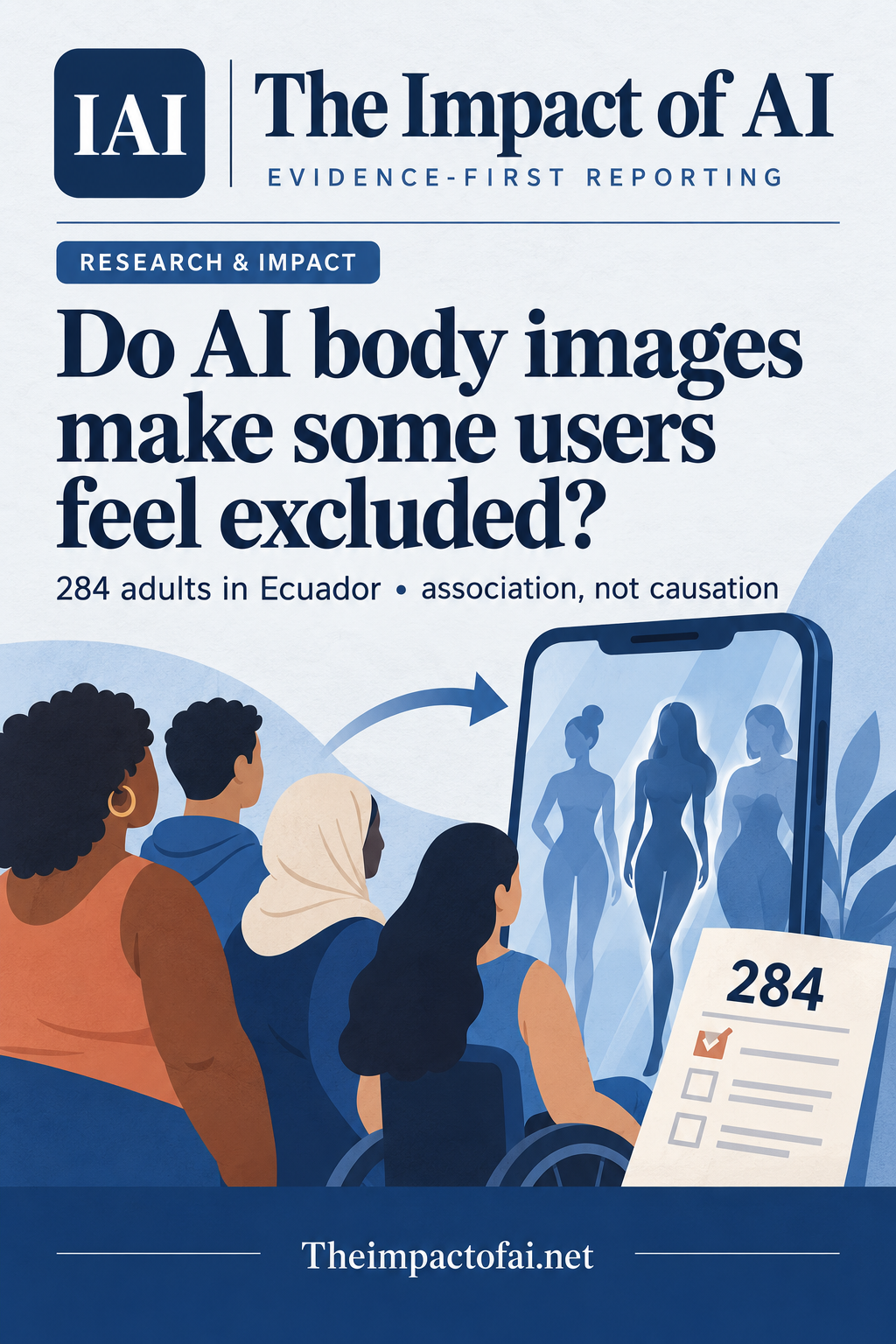
The study measured users' perceptions, not a platform's behaviour
Researchers asked how adult social-media users interpreted AI's role in image enhancement, which bodies they noticed in AI-generated material, whether they compared those images with themselves and whether they had felt excluded or judged online because of their body. That is a useful but deliberately bounded question. The study did not inspect a recommendation algorithm, sample outputs from a named image generator or test whether a platform suppressed any body type.
This distinction prevents two common overclaims. A person can perceive that AI favours thin or athletic bodies even when the specific systems they use have not been audited, and an audit can find representational skew without showing how any individual feels. The paper contributes evidence about the first level: reported perceptions and experiences. It cannot convert those reports into a measured property of every generative model or social network.[1]
The Impact Brief · Free
Follow the evidence in society & media.
Get a five-minute weekday briefing on what changed, why it matters and where the evidence comes from. Choose the topics you care about.
An open online survey produced 284 complete responses
The researchers distributed a questionnaire as an open link through digital channels. Participation was voluntary and self-selected, no sampling frame existed, and the link could be forwarded. The number of people who viewed the invitation is unknown, so a response rate cannot be calculated. The 284 analysed cases are all complete responses received between 5 October 2025 and 5 February 2026, not a random sample of Ecuador's adult population.
Of the 284 respondents, 264, or 93%, reported living in Ecuador; the remaining 20 lived elsewhere. The sample included 198 women, 82 men and four non-binary participants. The paper describes the group as predominantly Ecuadorian and is explicit that its gender imbalance limits estimates for men and does not support stable inference for non-binary adults. Eligibility was restricted to adults, and the first age category covered people aged 18 to 20.[1]
The instrument was piloted, but most focal measures were single items
The 20-question instrument covered demographics, body self-perception, digital experiences and perceived algorithmic bias. A 43-person pilot identified ambiguous wording, and five university faculty members with experience in psychology and information and communication technologies reviewed relevance and clarity. The paper reports an overall Cronbach's alpha of 0.80, while correctly declining to use that number as proof that each individual item is a validated psychological scale.
Body-related exclusion was measured with the direct question of whether the respondent had felt excluded or judged on social media because of their body, with no, not sure and yes options. Body comparison recorded whether the person compared their own image with AI-generated representations and whether they felt better or worse afterward. These are concrete exploratory indicators, not diagnoses of body-image disorder, mental-health harm or platform discrimination. Their precision remains tied to the exact question wording.[1]
The largest association was moderate; most were small
Comparison with AI-generated body images was associated with stronger perception that AI enhances photographs, with Spearman's rho of 0.32 and p below .001. The authors describe that relationship as moderate under conventional benchmarks. Perceived AI enhancement was associated with body-related exclusion at rho 0.24, also with p below .001, a small or weak relationship. Participants reporting comparison or exclusion were also more likely to say AI-generated bodies looked predominantly thin or athletic, but those coefficients were smaller.
Effect size matters more than the presence of a low p value. With 284 responses, a small association can be statistically detectable without explaining much of people's experience. The paper states that values near 0.20 are compatible with stronger unmeasured determinants and should not be described as evidence that AI is a dominant influence. Omnibus epsilon-squared values ranged from 0.028 to 0.106, again indicating small to moderate group differences rather than a sweeping effect.[1]
Adjusted models did not turn association into causation
Exploratory ordinal logistic models used the 280 respondents who identified as women or men because four non-binary respondents were too few for a stable comparison. After adjustment for gender and education, body-related exclusion remained associated with perceiving AI enhancement, with an odds ratio of 1.47, and with having compared one's body with an AI-generated representation, with an odds ratio of 2.30. Women had higher adjusted odds of reporting exclusion, while education was not significant in that model.
Those models explained only a modest share of variation: McFadden pseudo-R-squared values ranged from 0.026 to 0.063. Baseline body dissatisfaction, intensity of social-media use, frequency of AI-tool exposure and socioeconomic position were not measured. Adjustment for a few demographics cannot eliminate confounding or determine direction. People who already feel excluded may notice enhancement and narrow representation more readily; comparison may precede exclusion, follow it or share another cause.[1]
Gender differences were present but small
Women reported appearance-modifying filters more often than men: 53.0% of women and 74.4% of men said they never used them, while 9.1% of women and 2.4% of men reported frequent use. The gender difference had an effect size of r equals 0.20. Women were also more likely to agree that AI promotes thin bodies as a norm, but that effect was smaller at r equals 0.16. The paper cautions against equating statistical significance with a large difference.
The result should not be used to stereotype all women or ignore pressure experienced by men and non-binary people. Recruitment and gender composition can shape the apparent pattern, and the study was not powered for intersections of gender with age or education. A more representative study would recruit enough participants within prespecified groups and examine how platform use, culture, disability and socioeconomic position interact with appearance pressure.[1]
Practical design lessons are plausible, not experimentally proven
The findings support a reasonable design agenda: image generators and curation systems should be audited for body diversity, enhancement tools should make transformations intelligible, and platforms should give people meaningful control over appearance-focused recommendations. User research should include people with a wide range of body sizes and shapes before products are launched. Yet the survey cannot show that any particular intervention would reduce comparison or exclusion.
There are also countervailing possibilities. Generative tools can create representation that traditional media omitted, and ranking systems can be configured to surface body-diverse or body-neutral content. The relevant outcome depends on training data, product objectives, moderation, interface defaults and community practice—not an inevitable property of AI. Auditing systems and measuring user experience together would show whether a technical change alters what people actually see and feel.[1]
Funding, ethics and what would change the assessment
Universidad Politécnica Salesiana in Cuenca funded the work under grant UPS-GI-2025-027. Its ethics committee approved the survey procedure, participants gave digital informed consent, and the authors say responses were voluntary, anonymous and confidential. They declared no competing interests. Those safeguards address participation and disclosure but do not make the convenience sample representative or validate causal interpretation.
Confidence would rise with preregistered multi-country studies using probability or carefully stratified recruitment, validated multi-item measures and objective records of exposure. A longitudinal panel could establish whether changes in AI-image exposure precede changes in comparison or exclusion. An experiment could hold images constant while varying AI provenance or representation, and a platform audit could quantify what bodies are actually generated or recommended. Until then, the result is a useful signal from a predominantly Ecuadorian sample: perceived enhancement, comparison and exclusion travel together, but the study does not show that AI images caused harm.[1]
What this means for people
- People who compare themselves with AI-generated bodies may also be more alert to enhancement and narrow representation, but the study cannot say which experience came first.
- Design teams can treat perceived exclusion as a product-safety and inclusion signal without presenting the survey as proof of clinical harm.
- Educators and families should discuss how generated images are constructed while avoiding claims that every user or every platform is affected in the same way.
Global context
Most respondents lived in Ecuador, offering evidence from a Latin American setting often underrepresented in body-image research. That geographic contribution is important, but the convenience sample cannot stand in for Ecuador or Latin America. Cultural beauty norms, connectivity, platform mix and access to generative tools differ across countries, so cross-cultural replication should preserve local language and context rather than treating one survey as a universal estimate.
What the evidence does not yet show
- Recruitment used a freely shared online link with no sampling frame or computable response rate, so the sample is not representative of Ecuador.
- All measures were collected once by self-report, leaving temporal direction, common-method bias, recall and social-desirability effects unresolved.
- The study did not audit a named model, generator, recommendation system or platform output; perceived bias is not proof of measured system bias.
- Several focal constructs were single categorical items rather than validated multi-item scales, limiting measurement depth.
- The sample was weighted toward women and tertiary education, with only four non-binary respondents and limited support for subgroup inference.
- Important possible confounders—including baseline body dissatisfaction and actual AI-image exposure—were not measured.
What to watch next
- Longitudinal evidence establishing whether AI-image exposure precedes changes in body comparison or exclusion.
- Platform and model audits paired with user studies, so actual outputs and perceived effects are measured in the same design.
- Representative Latin American and cross-cultural samples using validated body-image and exclusion measures.
- Tests of whether diverse training data, transparent enhancement controls or recommendation settings change user outcomes.
Living evidence record
Impact record IAI-1Q9H2MO
Evidence stage
Studied
Confidence
Supported
Reporting basis
Source analysis
Independent or research support
Present
Record status
Monitoring
Last checked
5 October 2026
Source trail
1 direct source across 1 source type.
People impact
Documented in this record.
Uncertainty
Limits and next checks are explicit.
Stages describe the evidence available—not whether a technology is good or bad. See the public method.
Single-source reporting disclosure
This record analyses one direct source. It can establish what Current Psychology published or reported, but it is not independent corroboration of every performance claim or predicted outcome. The confidence label will change only when broader evidence is added.
Evidence trail
Sources used for this report
Links checked 5 October 2026
This report is labelled source analysis. We summarise and analyse source material in our own words; company statements remain attributed claims until independently supported. Translated summaries preserve the meaning of the original source and link back to it. Read our editorial standards.
Continue the story
Related reporting
Society & Media
Why do people see ChatGPT so differently?
Convenience samples in Germany and Serbia differed sharply in AI literacy and in whether they saw ChatGPT as useful or risky. The study maps associations among knowledge, beliefs and attitudes, but its self-report design cannot show that literacy caused trust or that the samples represent either country.
10 min · 1 source
Society & Media
Why was an AI review retracted?
New analysis today of a 3 October retraction notice. Springer Nature says contextually incorrect references may indicate undeclared generative-AI use in a 2024 review and that the authors did not provide a satisfactory explanation; the notice does not prove which tool was used, how much text it produced or a field-wide failure rate.
7 min · 2 sources
Society & Media
Can generative AI test how two timber traditions converged?
A peer-reviewed Chinese proof of concept fine-tunes two Stable Diffusion LoRA modules on 58 northern and 61 southern timberwork images, then compares controlled interpolations with 27 Yangzhou references. The middle of the model space resembles the usable historical samples, but this is compatibility—not proof of how history happened.
8 min · 1 source
Reader commentary
Add evidence, experience or a question
No account is required. Reader notes are published after a brief civility, relevance and safety check; disagreement is welcome.
Explore commentary across the portal →Published reader notes
0No published reader notes yet. You can start the evidence-led discussion above.
Prefer a private correction or response? Contact the newsroom.