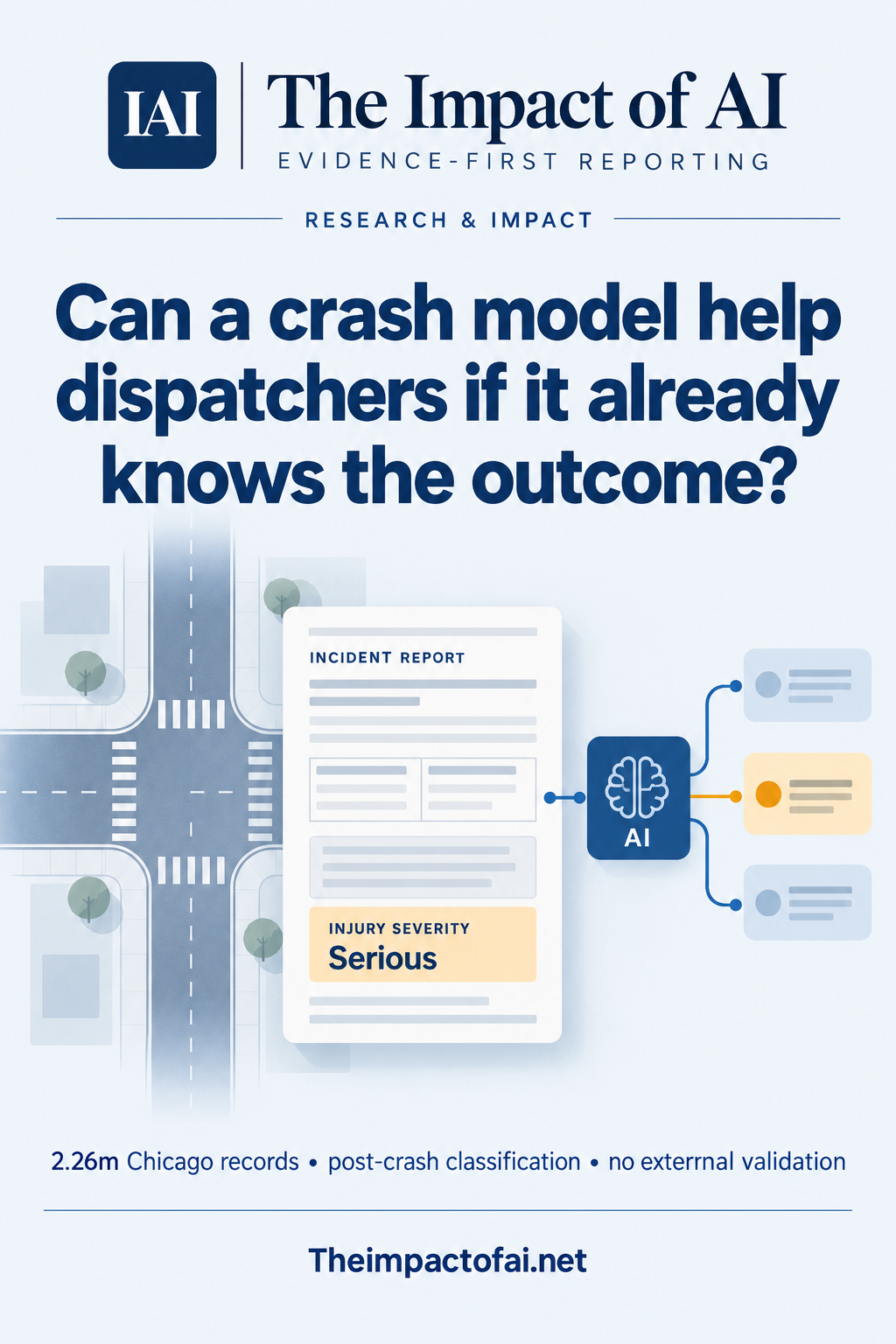
Can a crash model help dispatchers if it already knows the outcome?
A Chicago-record model reported a 99.85% AUC, but its main 37-feature pipeline included seven injury-outcome fields. The paper describes post-crash classification—not prospective dispatch prediction—and does not report results for its reduced feature check.
Editorial responsibility: The Impact of AI Editorial Desk · Report a factual concern
At a glance
- 1The merged Chicago dataset contains 2,263,315 person/vehicle-crash rows—not 2.26 million unique crashes—and groups all rows sharing a crash identifier into the same partition.
- 2The final 37-feature pipeline reported 97.54% accuracy, 97.67% macro-F1 and 99.85% AUC on 452,663 test rows after stacking and cost-sensitive calibration.
- 3Seven inputs directly describe injury outcomes, so the authors define the task as post-crash severity assessment. Appendix A names a 30-feature rerun without those fields but provides no performance results.
Research topic
Whether a calibrated stacking ensemble can classify severe injury status in completed Chicago crash records, and whether its reported performance supports prospective emergency dispatch
The headline result belongs to a completed crash report
The study asks whether a cost-sensitive ensemble can separate severe from non-severe injury status in a large merged set of Chicago traffic records. Its final pipeline reports 97.54% accuracy, 97.67% macro-F1 and an area under the receiver operating characteristic curve of 99.85%. Those are high discrimination figures, and the paper goes further by describing the framework as ready for emergency-dispatch integration.
The intended timing matters more than the headline score. The locked 37-feature set contains INJURIES_TOTAL, MOST_SEVERE_INJURY and five counts for fatal, incapacitating, non-incapacitating, reported-but-not-evident and no-indication injuries. These fields encode the outcome the model is meant to classify. The authors therefore explicitly call the experiment a post-crash severity assessment based on an observed, completed record and warn that it is not evidence of pre-crash or pre-outcome prediction.
That leaves a narrower possible use: checking, standardising or triaging records after injury information has already been recorded. It does not demonstrate that an emergency dispatcher could use information available at the first call to decide how many crews to send, whether advanced life support is needed or where to route a patient. Those prospective decisions require a model restricted to variables available before the injury outcome is known.[1]
The Impact Brief · Free
Follow the evidence in science & research.
Get a five-minute weekday briefing on what changed, why it matters and where the evidence comes from. Choose the topics you care about.
More than two million rows are not two million independent crashes
The researchers combined the Chicago Traffic People, Traffic Crashes and Traffic Vehicles datasets, which originate in police reports and, for some minor property-damage incidents, driver self-reports. The resulting table contains 2,263,315 person/vehicle-crash records: 1,605,727 labelled no injury and 657,588 labelled injury. A collision with several people and vehicles contributes several rows, so the paper cautions that this is not the number of unique crashes.
That structure creates an obvious leakage hazard: records describing the same collision could otherwise appear in both development and evaluation data. The authors address it by grouping every row with the same CRASH_RECORD_ID into one partition. Their selected comparison uses an 80:20 split, leaving 452,663 rows for testing. Preprocessing, interaction mining, Bayesian tuning, out-of-fold stacking and calibration are described as being contained within the relevant development partitions.
The model itself combines Random Forest, Gradient Boosting, Histogram Gradient Boosting and cost-sensitive Extra Trees through a logistic-regression meta-learner. It adds selected second-order feature interactions, uses Optuna for hyperparameter search, applies hybrid SMOTE-ENN resampling and isotonic calibration, then chooses thresholds that weight recall more heavily than precision. This is a substantial modelling pipeline, but methodological sophistication does not solve the timing problem created by outcome fields.[1]
The error reductions need a careful denominator
The final stage correctly classified 128,624 severe rows and missed 2,894, a severe-class false-negative rate of about 2.2%. It correctly classified 317,676 non-severe rows and produced 5,067 false alarms, a non-severe false-positive rate of about 1.6%. Relative to the immediately preceding stacking stage, where the corresponding rates were 3.8% and 2.5%, the paper’s reported 42% and 36% relative reductions are arithmetically consistent.
Elsewhere, however, the discussion says the same 42% reduction runs from 9.88% to 2.2%, and says a 36% reduction runs from 1.09% to 1.6%. Those pairs are inconsistent: 9.88 to 2.2 is a much larger relative fall, while 1.09 to 1.6 is an increase. The abstract’s claim of 54,000 additional correct classifications also differs from a later extrapolation of approximately 26,900 based on a 1.19-point accuracy gain. These editorial and denominator conflicts are material when the claimed benefit is framed in operational terms.
A deployment assessment would also need event-level rather than repeated-row consequences. Multiple correct rows from one collision do not represent multiple correctly handled incidents, and extrapolating a test-set accuracy difference across the entire merged table does not show how many dispatch decisions, injuries or lives would change.[1]
The paper acknowledges the decisive missing test
Appendix A says the complete five-stage pipeline was rerun after removing all seven injury-outcome fields, leaving 30 predictors and retaining the crash-grouped split, tuning, stacking and calibration. But the appendix stops after describing that setup. It does not provide the reduced model’s accuracy, recall, calibration, confusion matrix or uncertainty. Readers therefore cannot quantify how much of the near-perfect headline performance survives when the most outcome-proximate variables disappear.
The authors also identify limits in the source labels. Less visible crashes may be underreported, delayed or internal injuries may be misclassified at the scene, and officers can code causes or conditions differently. The metrics measure agreement with recorded police classifications, not an independent clinical ground truth. There is no temporal holdout, independent city, prospective emergency-centre evaluation or test across jurisdictions with different reporting practice.
Calibration was evaluated through expected calibration error and Brier score, with a reported post-isotonic ECE of 0.0004. That suggests close agreement between predicted probabilities and recorded outcomes in the study data, but it does not establish calibration after a shift in time, city, population or reporting rules. Calibration must be rechecked wherever the system would actually be used.[1]
What this means for dispatchers and the public
The practical result is not a new dispatch tool. Emergency call-takers still need evidence built from information they can obtain at the decision point: caller descriptions, sensor data, location, speed or impact estimates, vehicle type, occupancy and other features available before injury status is documented. A model evaluated after the outcome is recorded can help audit data or test modelling methods, but it cannot inherit a prospective claim through wording alone.
A credible next step would preregister an eligibility timestamp for every input, publish complete results for the 30-feature variant, lock the model and evaluate it on later Chicago crashes and at least one external city. The test should report unique incidents and patient-relevant outcomes, compare with existing dispatcher practice, measure calibration and subgroup performance, and examine whether model use changes response time or resource allocation without increasing harmful false alarms.
The authors are affiliated with universities in Saudi Arabia and Egypt, declared no competing interests and reported no funding. The Chicago datasets are publicly available. Those disclosures do not resolve the evidence gap, but they make the central conclusion clear: this is a large, group-aware post-crash classification experiment whose prospective public-safety value remains untested.[1]
What this means for people
- Dispatchers should not treat the reported 99.85% AUC as evidence that the system can predict severity from an initial emergency call.
- Residents could benefit from better triage only after prospective testing shows faster appropriate responses without unacceptable false alarms.
- Data teams may find the group-aware split and calibration workflow useful, while still needing to remove outcome fields before deployment claims.
Global context
The data describe Chicago, while the authors are based in Saudi Arabia and Egypt. Crash reporting, emergency resources, road design and injury coding vary between jurisdictions. A model trained against one city’s recorded classifications cannot be assumed to transfer to other US cities or countries without local validation, operational testing and governance.
What the evidence does not yet show
- The 2,263,315 observations are repeated person/vehicle-crash rows, not unique independent collisions.
- Seven of the 37 main inputs directly encode injury outcomes; the paper says the task is post-crash assessment, not prospective dispatch prediction.
- The appendix does not report performance for the stated 30-feature rerun that removes those outcome variables.
- Police and driver reports are vulnerable to underreporting, delayed-injury misclassification and inconsistent coding.
- There was no external city, temporal holdout, prospective deployment or comparison with actual emergency-dispatch decisions.
- Several narrative claims about percentage reductions and extrapolated correct classifications conflict with the paper’s own tables or other passages.
What to watch next
- Complete results for the reduced feature set restricted to operationally available information.
- A locked temporal test on later Chicago crashes followed by validation in other cities.
- Event-level rather than repeated-row outcomes, with calibration and subgroup performance.
- Prospective evidence that model-assisted triage changes response decisions safely and usefully.
Living evidence record
Impact record IAI-0XB3RN9
Evidence stage
Studied
Confidence
Supported
Reporting basis
Source analysis
Independent or research support
Present
Record status
Monitoring
Last checked
4 October 2026
Source trail
1 direct source across 1 source type.
People impact
Documented in this record.
Uncertainty
Limits and next checks are explicit.
Stages describe the evidence available—not whether a technology is good or bad. See the public method.
Single-source reporting disclosure
This record analyses one direct source. It can establish what Scientific Reports published or reported, but it is not independent corroboration of every performance claim or predicted outcome. The confidence label will change only when broader evidence is added.
Evidence trail
Sources used for this report
Links checked 4 October 2026
This report is labelled source analysis. We summarise and analyse source material in our own words; company statements remain attributed claims until independently supported. Translated summaries preserve the meaning of the original source and link back to it. Read our editorial standards.
Continue the story
Related reporting
Science & Research
Did the arthritis AI travel between cohorts?
A peer-reviewed analysis of gut-microbiome data from 2,238 people reached a mean internal ROC-AUC of 0.834, but its genus-level model fell to 0.439 in 39 independently processed Shanghai samples. The study is a warning about cross-cohort transfer, not evidence for a rheumatoid-arthritis diagnostic test.
8 min · 1 source
Science & Research
Can more data fix measurement errors in AI?
No, not in these simulations. Across five model families, noisy or misassigned input features reduced predictive performance and distorted feature-importance rankings; larger samples narrowed variation but did not remove the bias.
7 min · 1 source
Science & Research
Why did AI vision miss a human illusion?
New analysis today of a peer-reviewed 2 October Current Biology experiment. Motion adaptation shifted human judgements and position codes decoded from macaque inferior-temporal cortex, while nine tested artificial-vision networks did not reproduce the effect on their own; this is a targeted benchmark, not proof that the models cannot localise objects.
8 min · 3 sources
Reader commentary
Add evidence, experience or a question
No account is required. Reader notes are published after a brief civility, relevance and safety check; disagreement is welcome.
Explore commentary across the portal →Published reader notes
0No published reader notes yet. You can start the evidence-led discussion above.
Prefer a private correction or response? Contact the newsroom.