Can AI detect attack types it never saw in training?
A hybrid Transformer–LSTM detected two held-out categories in the UNSW-NB15 benchmark, with 88.13% recall on the combined unseen subset. It was a binary, row-level laboratory test—not evidence of live zero-day defence.
Editorial responsibility: The Impact of AI Editorial Desk · Report a factual concern
At a glance
- 1The researchers restructured the public UNSW-NB15 dataset so Shellcode and Worms records were absent from training and validation and appeared only in the final test.
- 2Across the full final test, the model reported 94.04% accuracy and 95.34% F1; recall on the combined held-out categories was lower at 88.13%.
- 3The test classified individual flow records as benign or malicious; it did not identify the held-out family, run on a live network or measure analyst outcomes, latency or resilience to drift.
Research topic
Whether a hybrid deep-learning model can label traffic from attack categories deliberately excluded from training as malicious and provide feature-attribution evidence
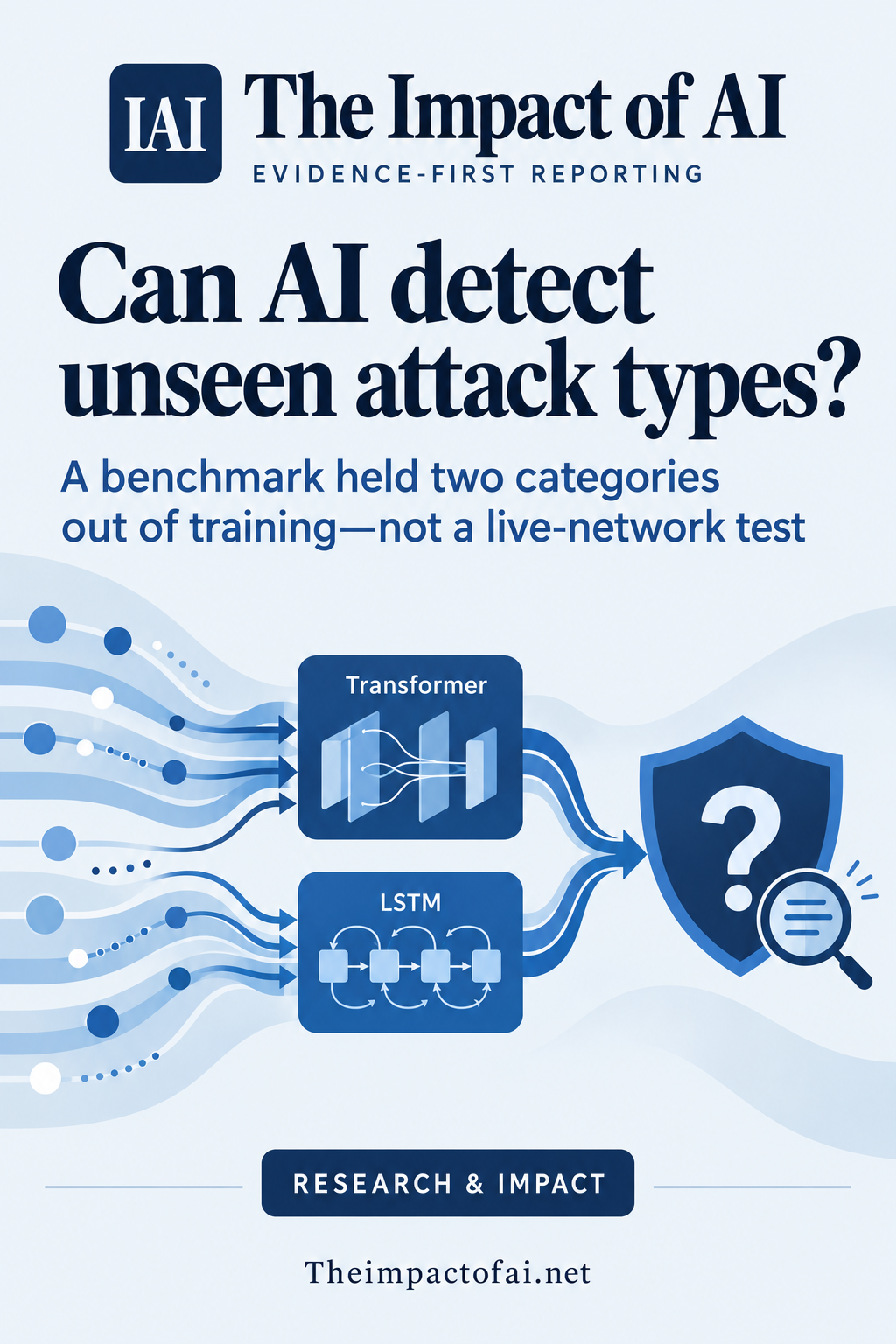
The paper tests an unseen-category problem, not a newly discovered vulnerability
A new cybersecurity paper reports that a hybrid deep-learning model could flag traffic from two attack categories excluded from its training data. The result is relevant to a recurring weakness in intrusion detection: models can look strong when the same attack families appear on both sides of a train-test split. By holding out Shellcode and Worms records until final evaluation, the authors created a harder and more informative benchmark.
The word 'zero-day' needs care. In this experiment it means that those two labelled categories were unseen during model development. The model did not encounter a new software vulnerability, unknown malware campaign or live attacker. It performed binary classification—benign versus malicious—and did not name the held-out attack family. The study therefore tests generalisation within a known public dataset, not operational protection against tomorrow's exploit.[1]
The Impact Brief · Free
Follow the evidence in security & defence.
Get a five-minute weekday briefing on what changed, why it matters and where the evidence comes from. Choose the topics you care about.
The denominator is large, but it comes from one synthetic benchmark
UNSW-NB15 was created at the Australian Centre for Cyber Security using the IXIA PerfectStorm traffic generator. The source contains about 100 gigabytes of captured traffic, 2,540,044 flow records and nine attack categories plus normal activity. The study used the benchmark's smaller predefined train and test tables—82,332 and 175,341 records—as its starting point, then merged and repartitioned them for the holdout design.
Exact duplicate rows were screened before splitting, and identifier, attack-category and holdout indicator fields were removed from model inputs. Categorical variables were encoded and transformations were fitted only on training data. Those choices reduce obvious leakage. However, the splits were made at the individual flow-record level, not by network session, device, time period or organisation. Related traffic patterns may therefore appear across partitions even when exact duplicates and the two held-out labels do not.[1]
The architecture combines global and sequential representations
ZD-HybridNet has two branches. A Transformer encoder is intended to capture interactions among traffic features, while an LSTM branch models ordered dependencies. An adaptive gate combines their representations. The pipeline also adds an Isolation Forest anomaly score, uses attention pooling and class-weighted training, and applies SHAP feature attribution after prediction. The authors compare the complete system with stand-alone LSTM, Transformer, FT-Transformer and one-dimensional convolutional models under the same preprocessing and partition rules.
On the full final test set, ZD-HybridNet reported 94.04% accuracy, 96.76% precision, 93.96% recall and 95.34% F1. Its test ROC-AUC was 0.9893. The strongest stand-alone Transformer trailed by 1.68 percentage points in accuracy and 1.71 points in F1. Ablations also reduced performance when attention pooling or adaptive fusion was removed, suggesting the components contributed inside this experimental setup.[1]
Subgroup recall is more revealing than the headline accuracy
The final test combined a random portion of known-category records with all Shellcode and Worms records. High aggregate metrics can therefore be dominated by traffic types that the model has already seen. The authors separately report recall of 94.26% on known attacks and 88.13% on the combined held-out subset. Shellcode was detected more readily than the rarer Worms category, though the accessible paper text does not make the smaller family's operational consequences equivalent to a production incident rate.
That decline is not a failure; it is the point of the harder evaluation. It shows why readers should ask how many genuinely held-out cases exist and how a model behaves on them, rather than treating overall accuracy as proof of zero-day protection. Because only one two-category configuration was tested, the result may depend on how similar Shellcode and Worms flows are to known malicious traffic. Other holdouts, newer data or different environments could yield different performance.[1]
Explainability here means attribution, not a verified analyst rationale
The paper combines internal attention and fusion signals with SHAP values to show which inputs influenced predictions. Feature attributions can help an analyst inspect whether a flag rests on plausible traffic characteristics and can reveal that a model is exploiting an artefact. They do not prove that the highlighted features caused malicious behaviour, and a readable explanation is not necessarily faithful under distribution shift or adversarial manipulation.
No user study tested whether security analysts made faster or better decisions with the explanations. The authors also say their explanations should not be interpreted as causal or real-time operational accounts. Before adoption, teams would need representative false-positive and false-negative cases, stability tests, local explanations for held-out attacks and evidence that the presentation improves triage rather than creating automation bias.[1]
Real networks add costs and failure modes the benchmark does not measure
The study did not quantify inference latency, throughput, model memory use or explanation-generation time. It did not test encrypted traffic, changing protocols, organisation-specific baselines, sensor failures, adversarial evasion or continuing model updates. The authors acknowledge that deployment-oriented computational validation is still needed. A security operations centre also cares about alerts per hour and investigation cost, not only record-level accuracy.
The confusion matrix for the full test reported 1,078 benign flows incorrectly labelled as attacks and 2,072 attacks missed among the evaluated records. Those counts are informative within the benchmark but cannot be converted directly into production workload because live base rates and traffic correlations differ. A model with strong recall can still swamp analysts if malicious events are rare and benign volume is enormous.[1]
The data are public; the study reports no funding or competing interests
The paper says no funding was received and the authors declare no competing interests. UNSW-NB15 is publicly available through the UNSW research repository and a Kaggle mirror; the study generated no new primary dataset. Public inputs make independent reconstruction possible, though exact code, trained weights and repeated-run variability are also important for checking a complex pipeline.
A further test should preserve chronological or session boundaries, repeat training across random seeds, and compare against simpler anomaly detectors as well as deep baselines. Cross-dataset evaluation would show whether the model learned malicious structure or benchmark-specific signatures. Prospective shadow deployment—where predictions do not yet trigger action—could measure throughput, alert burden and drift without exposing a network to an unproven control.[1]
What would change the assessment
Evidence would strengthen if the model retained performance across multiple pre-specified held-out category combinations, time-separated traffic and organisations not represented in training. Results should include confidence intervals across repeated runs, precision and recall at realistic base rates, alert volumes per unit of traffic, calibration and the consequences of misses. Adversarial evaluation should test evasion, poisoning and explanation instability.
The decisive step is a live or high-fidelity prospective evaluation against a locked model, with human analysts and existing tools as comparators. Researchers should report whether explanations change investigation accuracy and time, and whether compute demands fit operational constraints. Until then, ZD-HybridNet is a promising benchmark result with a comparatively careful category holdout—not evidence that an organisation can deploy it today and reliably stop unknown attacks.[1]
What this means for people
- Security teams should read the result as a benchmark, not a guarantee that a deployed model will recognise a new exploit.
- Analysts could benefit from reviewable feature attributions, but those explanations need usability and faithfulness testing.
- Organisations would need to measure false-alert workload and missed attacks at their own traffic base rates before operational use.
Global context
UNSW-NB15 was generated in an Australian research laboratory and is widely used internationally, which helps comparison but can encourage repeated optimisation to one benchmark. Network protocols, services, attack techniques and benign behaviour vary across regions and organisations and change over time. Global relevance depends on tests across contemporary enterprise, industrial, cloud and edge environments under local privacy and security constraints, not on transferring the reported threshold unchanged.
What the evidence does not yet show
- The evaluation used one public, generated network-traffic benchmark rather than current live traffic from independent organisations.
- Only Shellcode and Worms were held out; other unseen-category configurations were not tested.
- Splits were made at the flow-record level rather than by session, time or network, leaving possible dependence among related records.
- The binary model detected malicious traffic but did not identify the held-out attack family or a previously unknown vulnerability.
- Latency, throughput, memory, explanation time, repeated-run uncertainty and analyst outcomes were not measured.
- SHAP and attention signals describe feature influence, not causation or guaranteed faithfulness under attack or distribution shift.
What to watch next
- Independent cross-dataset tests and time-separated evaluations on newer traffic.
- Multiple pre-specified category holdouts with repeated runs and confidence intervals.
- Session- or network-grouped partitions that reduce dependence between train and test records.
- Shadow deployments reporting alert volume, latency, compute and analyst performance.
- Adversarial robustness and stability of explanations when traffic patterns change.
Living evidence record
Impact record IAI-0AKKY0P
Evidence stage
Studied
Confidence
Supported
Reporting basis
Source analysis
Independent or research support
Present
Record status
Monitoring
Last checked
5 October 2026
Source trail
1 direct source across 1 source type.
People impact
Documented in this record.
Uncertainty
Limits and next checks are explicit.
Stages describe the evidence available—not whether a technology is good or bad. See the public method.
Single-source reporting disclosure
This record analyses one direct source. It can establish what Discover Artificial Intelligence published or reported, but it is not independent corroboration of every performance claim or predicted outcome. The confidence label will change only when broader evidence is added.
Evidence trail
Sources used for this report
Links checked 5 October 2026
This report is labelled source analysis. We summarise and analyse source material in our own words; company statements remain attributed claims until independently supported. Translated summaries preserve the meaning of the original source and link back to it. Read our editorial standards.
Continue the story
Related reporting
Security & Defence
Can phishing models learn without pooling URLs?
A peer-reviewed benchmark tests seven classifiers on 11,430 labelled URLs and simulates federated learning across 20 clients. XGBoost leads centrally, while a feature-weighted neural model stays competitive without moving raw examples—but no real organisations or live traffic were tested.
9 min · 2 sources
Security & Defence
Who holds AI agents accountable when they reach government systems?
The UK privacy regulator has opened enquiries into recent AI-agent testing and launched a six-week evidence call, while Australia, Canada and California are pursuing different accountability routes. None has yet produced a final finding on the reported agent incidents.
15 min · 10 sources
Security & Defence
Can reduced AI safeguards give cyber defenders an advantage?
Anthropic has opened three levels of less-restricted cyber access and reports 129,000 partner-identified vulnerabilities. Its 50-trial evaluation shows the access controls behave differently, but the effectiveness totals are company-reported and do not establish how many unique flaws were fixed.
8 min · 2 sources
Reader commentary
Add evidence, experience or a question
No account is required. Reader notes are published after a brief civility, relevance and safety check; disagreement is welcome.
Explore commentary across the portal →Published reader notes
0No published reader notes yet. You can start the evidence-led discussion above.
Prefer a private correction or response? Contact the newsroom.