Can AI-controlled droplets make colour tests more reliable?
In laboratory tests, a digital microfluidic platform moved nanolitre droplets, watched colour reactions and adapted its measurement strategy. The peer-reviewed system is technically promising, but it was not clinically validated.
Editorial responsibility: The Impact of AI Editorial Desk · Report a factual concern
At a glance
- 1The platform combined a digital microfluidic chip, camera-based droplet tracking, path planning and assay-specific models so that droplets could be moved, split, merged and remeasured without a person manually running each step.
- 2Public extended data report 97.6% classification accuracy for a pH task and 93.3% for a protein assay; copper-concentration fits had R² values of 0.956 in bottled, 0.949 in tap and 0.911 in lake water.
- 3The evidence is laboratory and engineering validation, not patient-outcome evidence. Five independent training/evaluation runs were reported for the cross-domain transfer comparison, and several authors disclosed related microfluidics or biotechnology companies.
Research topic
Whether machine vision and closed-loop control can make nanolitre colorimetric assays more adaptive, automated and resistant to weak signals or interference
The answer is promising in the laboratory, not proven in care
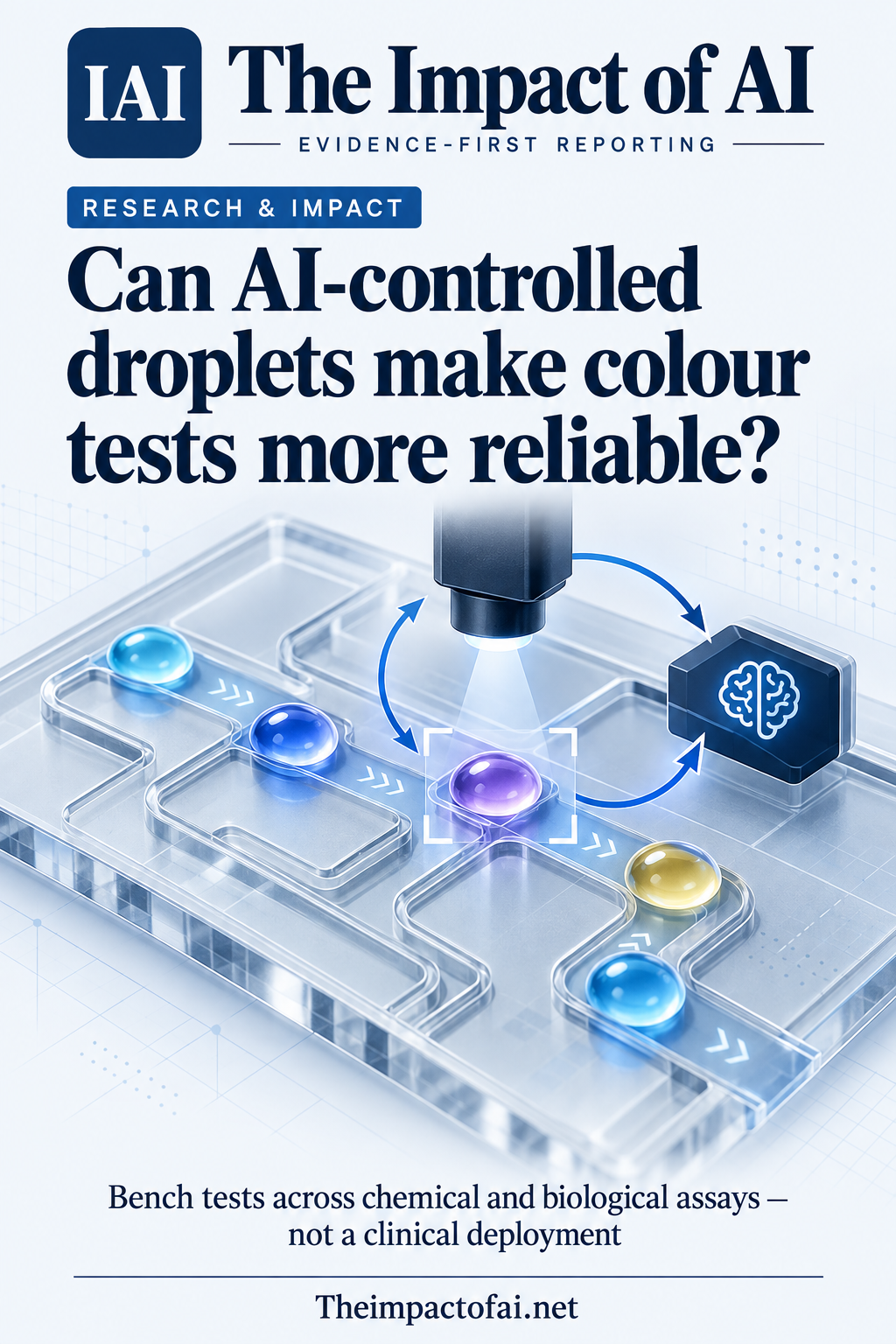
A peer-reviewed Nature Sensors paper published on 5 October describes a laboratory platform that does more than photograph a colour test. It moves nanolitre droplets on a digital microfluidic chip, identifies their position and state with machine vision, selects collision-free routes, and can change the measurement process when a signal is saturated, weak or contaminated by background colour. Across chemical and biological demonstrations, the system produced strong task-specific results and used transfer learning to adapt between assays.
That is a meaningful engineering advance, but it is not evidence that the platform improves diagnosis or patient outcomes. The paper reports controlled bench assays, cultured bacteria, water matrices and model-evaluation runs. It does not report a prospective clinical cohort, a comparison with clinicians, sensitivity and specificity in a target patient population, or decisions made under routine laboratory conditions. Readers should therefore separate automation of an analytical process from validation of a medical test.[1]
The Impact Brief · Free
Follow the evidence in science & research.
Get a five-minute weekday briefing on what changed, why it matters and where the evidence comes from. Choose the topics you care about.
What the platform actually does
The researchers call the system intelligent microdroplet analytical robotics, or IMAR. Its digital microfluidic surface uses addressable electrodes to move small droplets. An imaging module captures the chip, computer-vision software locates the droplets, and path-planning software sends movement commands back to the controller. The published workflow includes splitting and merging events as well as route calculation, turning what is usually a manually staged colour reaction into a closed feedback loop.
The analytical layer combines background subtraction, droplet masks and convolutional neural networks. When a reaction exceeds the usable colour range, the system can dilute and reconstruct the sample on the chip. For weak signals, an attention-guided mask concentrates the model on informative regions. To suppress interference, multiple droplets can be combined or compared. The paper says this nanolitre format reduced reagent consumption by five orders of magnitude relative to conventional volumes, although that efficiency claim does not by itself establish accuracy, cost or durability in a real service.[1]
The comparison spans several assay types
The public paper and extended-data record describe tests involving pH, copper and iron ions, hydrogen peroxide, nitrite, calcium, glucose, protein and microbial activity. The pH extension reported 97.6% classification accuracy and a regression R² of 0.990. A Coomassie Brilliant Blue protein assay, chosen because its colour changes are subtle, reported 93.3% classification accuracy and R² of 0.980 when the full pipeline combined the neural network, adaptive masking and a multi-sample strategy.
Those numbers answer narrow questions under the study's conditions. Classification accuracy depends on the tested concentration classes and their balance, while R² measures how well predictions track variation in the reference concentrations; neither metric is a universal measure of analytical safety. The paper's source-data links describe raw values, confusion matrices, ablation comparisons and exact statistical tests, but the denominators vary by experiment rather than forming one large validation sample. The cross-domain transfer analysis explicitly reports five independent training and evaluation runs for each strategy.[1]
Transfer learning helped when examples were limited
Instead of building a separate large image dataset for every colour reaction, the team transferred representations learned from one assay to another. In the glucose demonstration, training from scratch produced R² of 0.898. Models transferred from hydrogen peroxide, copper, pH, nitrite or calcium produced R² values from 0.909 to 0.956 in the public extended-data summary. The five-run comparison reported means and standard deviations and used paired two-sided t-tests.
This is relevant to laboratory automation because many useful assays do not generate the enormous labelled datasets associated with mainstream computer vision. Yet transfer between related bench reactions is still a controlled problem. The experiment does not show that a model trained in one laboratory will remain calibrated across different cameras, chips, lighting, reagent lots, operators or temperatures. It also does not establish performance on rare clinical presentations, where the cost of an apparently plausible but wrong result may be high.[1]
The interference tests are encouraging but bounded
For copper quantification, the platform was tested in bottled, tap and lake water. The reported fits had R² values of 0.956, 0.949 and 0.911 respectively, with performance declining in the more complex lake-water matrix. The researchers also added red, yellow, green and blue background pigments to test chromatic interference. These experiments address a real weakness of colour-based assays: unrelated colour or turbidity can obscure the reaction being measured.
The direction of the result is useful, but three water matrices and four artificial pigment conditions cannot represent every contaminant or field environment. Lake water from one setting is not a substitute for multi-site environmental validation, and laboratory-spiked interference may be easier to characterise than naturally varying mixtures. Practical use would require blinded samples, pre-specified acceptance thresholds, comparisons with established analytical instruments and failure reporting when the system cannot produce a trustworthy answer.[1]
For people, the near-term impact is on laboratory work
If independently replicated, closed-loop droplet handling could reduce repetitive pipetting, conserve expensive reagents and make small-batch assays easier to automate. That may matter in research laboratories, environmental monitoring and eventually decentralised testing. A system that notices saturation or interference and changes its own procedure could be more useful than one that merely outputs a score from a fixed image.
Automation also changes responsibility. Staff would need to know when the system has altered a protocol, whether its calibration remains valid and how to inspect an unexpected result. Smaller reagent volumes can lower waste, but the platform still needs specialised chips, imaging, control electronics and quality assurance. The paper does not provide a deployment cost comparison, throughput under routine staffing, maintenance burden or evidence that less experienced users obtain equivalent results.[1]
Funding, code and commercial interests are disclosed
The study was led by Chinese institutions including Beijing Institute of Technology, with collaborators in China and the United Kingdom. Funding came from national and municipal Chinese research programmes; the authors state that funders had no role in design, collection, analysis, publication decisions or manuscript preparation. The paper links source-data workbooks, supplementary material, peer-review reports and a public code repository for image processing, model training, transfer learning and path planning.
Three authors reported relevant commercial interests: two are co-founders of ACXEL Micro & Nano Tech, and one is a co-founder of Optoseeker Biotechnology. The paper says those interests did not influence the study. Disclosure does not invalidate the work, but independent replication is especially valuable when a platform may move toward commercial development. Verification should include the physical hardware, software, consumables and calibration procedure rather than only rerunning a model on released images.[1]
What would change the assessment
Confidence would rise with pre-registered, blinded replication across laboratories using chips, cameras and reagent lots produced independently of the original team. Each assay should report its full sample denominator, concentration distribution, detection limit, precision, false-result pattern and rate of unusable runs. Comparators should include the relevant standard instrument or manual method, not only alternative neural-network configurations. Stress tests should vary lighting, temperature, storage, contamination and operator experience.
Clinical claims would require a separate validation pathway: representative patient samples, a locked model and protocol, clinically meaningful reference standards, sensitivity and specificity with confidence intervals, and evidence on how results affect decisions and outcomes. Environmental deployment would need multi-site field samples and longitudinal stability. Until those studies exist, IMAR is best understood as an inventive laboratory automation platform with encouraging assay demonstrations—not a validated autonomous diagnostic service.[1]
What this means for people
- Laboratory staff could spend less time on repetitive droplet handling, but would need transparent logs and authority to challenge automated protocol changes.
- Lower reagent use could reduce cost and waste, although the study did not measure whole-service economics.
- Patients should not interpret the paper as evidence of a clinically approved autonomous diagnostic test.
Global context
The platform was led by Chinese research institutions with UK collaborators and targets widely used colorimetric methods. Its engineering ideas may travel globally, but laboratory infrastructure, reagent supply, regulation and quality systems differ substantially. Validation in one research consortium cannot substitute for local performance studies, especially where a result may guide clinical treatment or environmental enforcement.
What the evidence does not yet show
- The evidence comes from laboratory and engineering demonstrations rather than a prospective clinical or field deployment.
- Experimental denominators differ by assay; the public extended-data summary reports five independent runs for the transfer comparison but not one common validation cohort.
- High classification accuracy or R² under selected conditions does not establish diagnostic sensitivity, specificity, calibration or patient benefit.
- Water-matrix and pigment tests cover a limited set of interference conditions and locations.
- Cross-laboratory robustness to different chips, cameras, lighting, reagent lots and operators remains unproven.
- Several authors disclosed related commercial interests, increasing the value of independent hardware-and-software replication.
What to watch next
- Independent blinded replication across laboratories and independently manufactured chips.
- Full per-assay denominators, detection limits, error distributions and unusable-run rates.
- Comparisons with standard instruments, including cost, throughput, maintenance and staff intervention.
- Multi-site field validation for environmental assays and representative patient-sample studies for any clinical claim.
- Locked-protocol studies showing when adaptive actions improve results and when the system should refuse an answer.
Living evidence record
Impact record IAI-1L024DC
Evidence stage
Studied
Confidence
Supported
Reporting basis
Source analysis
Independent or research support
Present
Record status
Monitoring
Last checked
5 October 2026
Source trail
1 direct source across 1 source type.
People impact
Documented in this record.
Uncertainty
Limits and next checks are explicit.
Stages describe the evidence available—not whether a technology is good or bad. See the public method.
Single-source reporting disclosure
This record analyses one direct source. It can establish what Nature Sensors published or reported, but it is not independent corroboration of every performance claim or predicted outcome. The confidence label will change only when broader evidence is added.
Evidence trail
Sources used for this report
Links checked 5 October 2026
This report is labelled source analysis. We summarise and analyse source material in our own words; company statements remain attributed claims until independently supported. Translated summaries preserve the meaning of the original source and link back to it. Read our editorial standards.
Continue the story
Related reporting
Science & Research
Can AI choose the next drug-chemistry experiment?
A peer-reviewed Roche–ETH study used active learning to select 50 new substrates from a 22,253-molecule pool, then tested about 96 reaction conditions for each. A later graph model identified the observed reaction site for all ten prospectively tested substrates—but only within a narrow chemistry workflow, not drug discovery as a whole.
9 min · 2 sources
Science & Research
Did the arthritis AI travel between cohorts?
A peer-reviewed analysis of gut-microbiome data from 2,238 people reached a mean internal ROC-AUC of 0.834, but its genus-level model fell to 0.439 in 39 independently processed Shanghai samples. The study is a warning about cross-cohort transfer, not evidence for a rheumatoid-arthritis diagnostic test.
8 min · 1 source
Science & Research
Can AI uncertainty warn of tipping points?
A peer-reviewed study found a local collapse in forecast uncertainty for one diffusion-model architecture near transitions in three simulated networked systems, then observed related changes in 12 Mediterranean Sea records. The pattern depended on architecture, dynamics and training data and is not a validated universal early-warning detector.
9 min · 1 source
Reader commentary
Add evidence, experience or a question
No account is required. Reader notes are published after a brief civility, relevance and safety check; disagreement is welcome.
Explore commentary across the portal →Published reader notes
0No published reader notes yet. You can start the evidence-led discussion above.
Prefer a private correction or response? Contact the newsroom.